Norek Akdar · House Akdar / Kharet
Qur’Gal / Zarakh
Caldera complex
Tears · industrial processing · captured steam
TIÅMÅT / VOLCANOES & POWER
Norek Akdar controls the greatest volcanic prize: Qur’Gal, called Zarakh by the Akkad. He does not control every source. East of Zarakh along the Khur-Tarek Ridge, Ak-Malurk controls the Maw of Dazhuk inside Dazhuk / Qur’Daq, Tarek’s principal Tear-extraction complex and a competing source of supply.
01 / MORE THAN ONE MOUNTAIN
The southern Belt of Fire contains many active centers. Older Akkad calderas and lava fields carry their own resources. This atlas follows principal systems and regions; a caldera group or fissure field is not a single cone.
8 of 8 systems and regions
Norek Akdar · House Akdar / Kharet
Caldera complex
Tears · industrial processing · captured steam
Ak-Malurk the Gray · House Malurk / Tarek
Caldera complex
Maw of Dazhuk · Tears · eastern mineral fields · processing infrastructure
Ak-Malurk the Gray · House Malurk / Tarek
Composite volcanic complex
Tears · metal-bearing veins · geothermal process heat
Ak-Malurk the Gray · House Malurk / Tarek
Caldera complex
Tears · geothermal heat · industrial minerals
Kurat Surian · Regency of Surian
Fissure field
Basalt · limited mineral workings · geothermal springs
Regency of Nivek · House Nivek network
Hydrothermal caldera
Managed heat · building stone · mineral waters
Siran Gorath · Regency of Gorath
Shield and lava field
Lava stone · sheltered workings · route access
Local Aqmorita communities · no single regent
Coastal caldera group
Obsidian · salts · sheltered landings · local mineral exchange
No systems match these filters. Try another name or reset the filters.
02 / THE SYSTEM IN DETAIL
Southern Belt of Fire · Khur-Tarek corridor
Tiåmåt’s largest volcanic system. A dominant extraction network on sacred Aqmorita ground.
A broad volcanic complex with overlapping caldera structures, older intrusive bodies and repeatedly fractured margins. The largest system is not simply the tallest cone: much of its scale lies in the calderas and subsurface. Active vents, hot rock and hydrothermal circulation coexist with older cooled formations.
The Maw of Zarakh is the industrial complex inside the caldera system, not a second volcano. Norek’s leverage joins deep extraction to processing, custody, transport and scientific expertise. Steam capture supplies part of the operation’s water, but the condensate requires treatment. Losing a loading point or a ventilation sector can interrupt production far beyond the active working face.
Qur’Gal is a sacred name and presence for several Aqmorita traditions. Akdar’s administrative control does not erase that older relationship. Wealth rests partly on coerced Aqmorita labor and knowledge, making extraction a question of domination as well as engineering.
Workers, guards and technicians share the same damaged terrain with very unequal freedom to leave it. Heat tolerance offers no immunity to toxic gases, dehydration or collapse.
Maw → Zig’Zarakh → Slag Path → Ish’Erikdu → lower rail network
East of Zarakh · Khur-Tarek Ridge · Tarek
Tarek’s principal Tear-extraction system. House Malurk controls the complex, routes and deposits; the Ridge includes disputed mineral reaches.
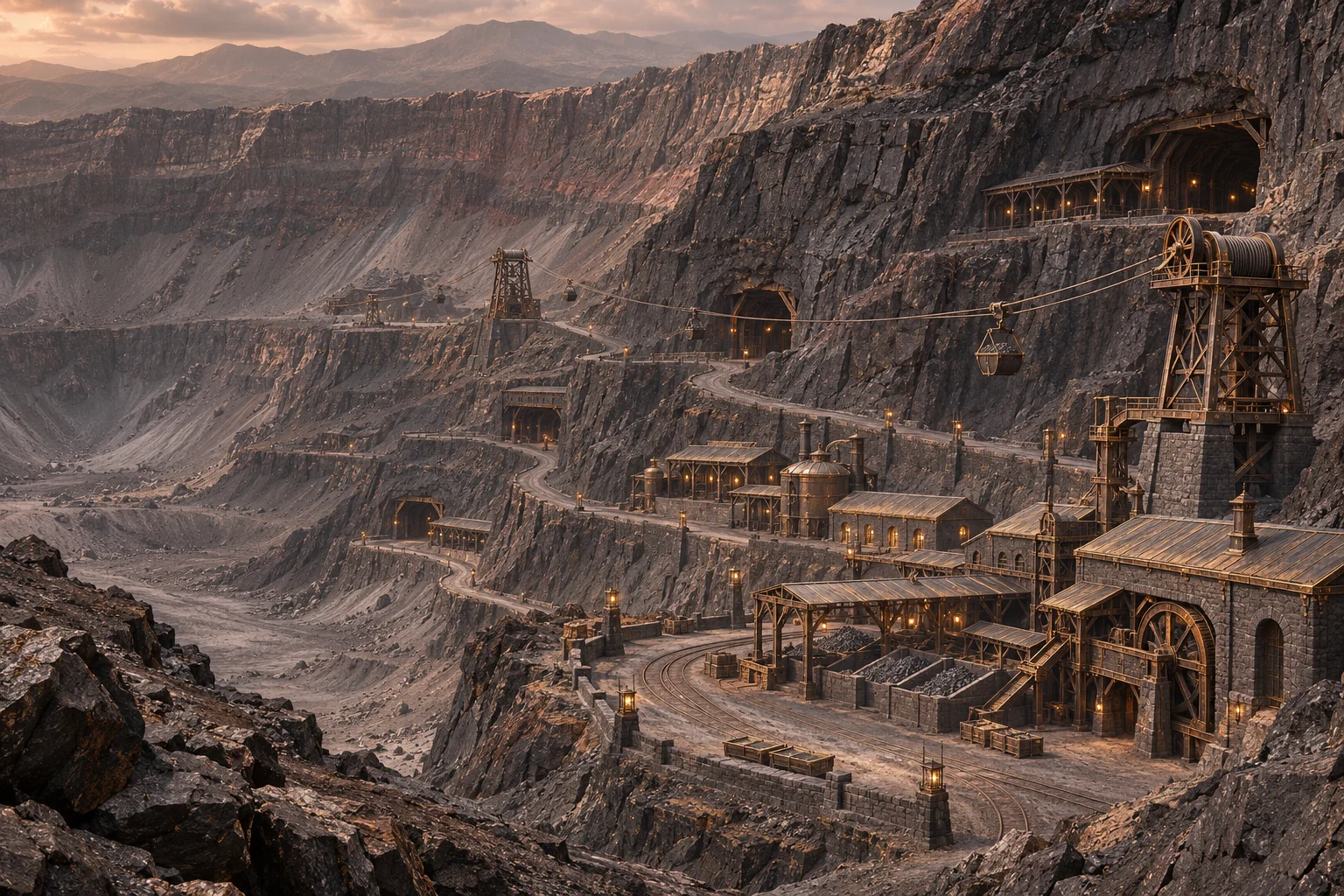
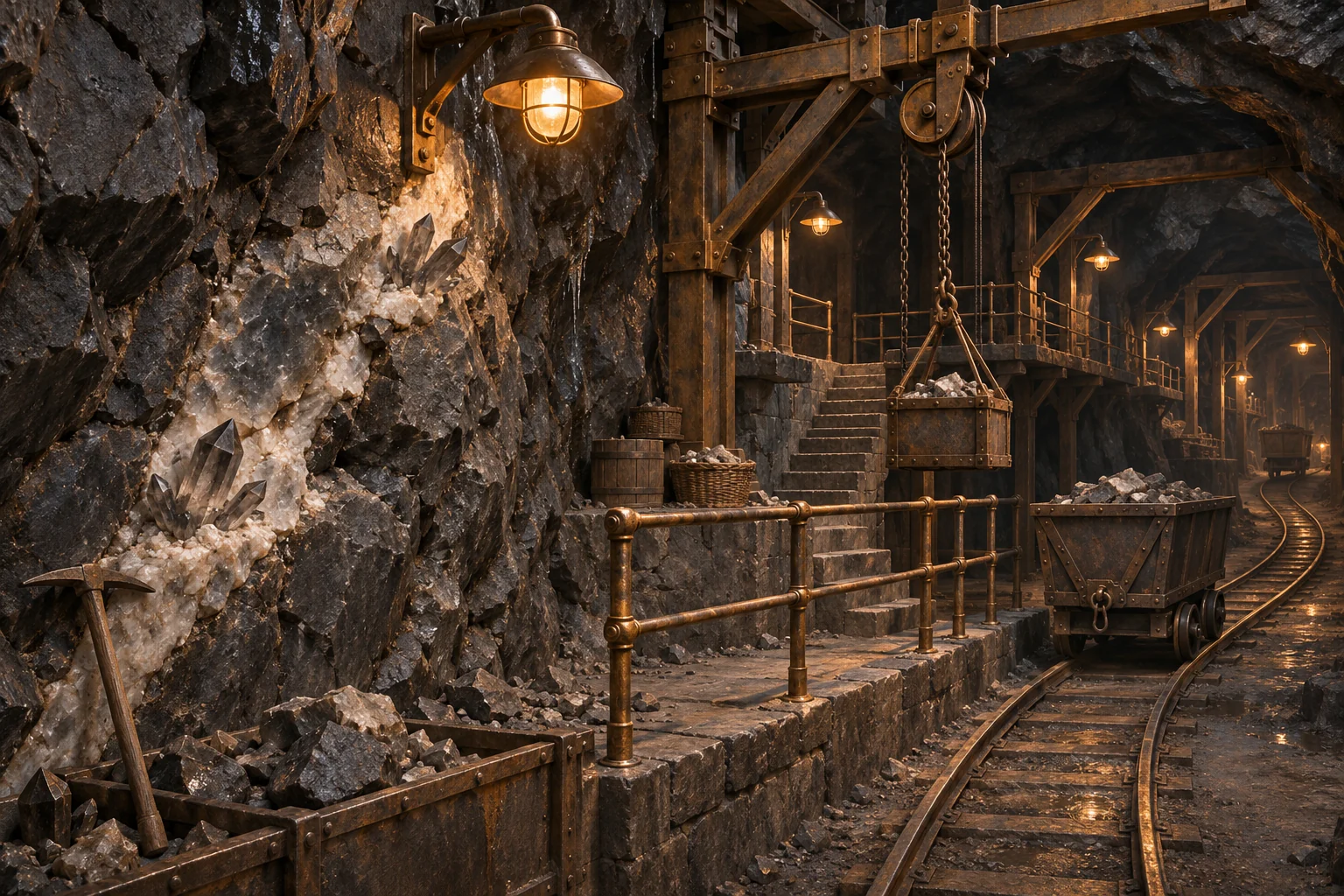
Dazhuk is the volcano known in Aqmorita tradition as Qur’Daq. Its caldera system contains the excavated Maw of Dazhuk. The volcano, the extraction complex and the surrounding mineral fields are connected but distinct parts of the landscape. Tear-bearing veins extend through Tarek and into disputed reaches of the Khur-Tarek Ridge.
The Maw of Dazhuk is the principal Tear-extraction complex of Tarek, excavated within the caldera system of Dazhuk, the volcano known in Aqmorita tradition as Qur’Daq. Located east of Zarakh along the Khur-Tarek Ridge, it anchors Tarek’s control over the eastern mineral fields and the veins extending through its territory and into the disputed reaches of the Ridge. The complex, its access routes, extraction works, processing infrastructure, and surrounding deposits are controlled by House Malurk under Ak-Malurk the Gray. Unlike the Maw of Zarakh, which belongs to the Akdar sphere of extraction, Dazhuk represents Tarek’s competing source of Tears and gives Ak-Malurk substantial economic and strategic leverage over Enkora’s energy network.
Ak-Malurk did not inherit Tarek peacefully. He broke with Akdar during the wars preceding the formation of the Kal-Muzar, conquered Tarek, destroyed its former ruling House, and seized control of the territory and its mineral infrastructure. His rule remained morally disputed, particularly by Norek Akdar, but the founders of the Kal-Muzar chose to recognize Tarek as one of the eight Domains because excluding it would have prolonged the war and left a powerful, resource-rich territory outside the new political order. The compromise deliberately separated recognition of the Domain from approval of its conqueror. The seat in the Kal-Muzar belonged to Tarek itself, not to House Malurk. Because Ak-Malurk controlled Tarek, he was permitted to occupy that seat and represent the Domain, even though the Kal-Muzar never declared his conquest or the destruction of the previous ruling House morally legitimate.
Work in the caldera depends on maintained approaches, extraction works and processing infrastructure. House Malurk’s control reaches those routes and installations as well as the surrounding deposits. The same links that carry the mineral also shape access to work and supplies.
Maw of Dazhuk → controlled access routes → Tarek processing network
The Maw of Dazhuk ↗ House Malurk ↗ Tarek’s territorial seat ↗
Tarek side of the Khur-Tarek Ridge
A complementary mining complex in Tarek. Deep mineral continuity across a contested frontier.
Successive lava flows and fragmental deposits build steep flanks around several vents. Older intrusions and mineralized fractures extend beneath the visible mountain. Altered rock can be weak even where the surface appears quiet, while the youngest vents restrict which approaches remain usable.
Alongside the principal Maw of Dazhuk, qur’Dareq provides a concentrated source of ore for Malurk’s refining network. Sorting, reliable handling and the ability to move a load away from the ridge matter as much as a rich seam. Its value is strategic: buyers with a second supplier gain bargaining room against Akdar’s industrial network.
This is one of the Gray Regent’s most controversial assets. A boundary surveyed on the surface does not reveal the path of a deep vein. Kharet and Tarek dispute rights of access, underground advance and compensation. Each can describe a gallery as legitimate work or an intrusion, depending on where the claim begins.
Mining settlements depend on both the mountain and the road out. A closure can strand wages, food and water behind the same barrier that stops the ore.
Ridge galleries → Tarek ore yards → Malurk refining network
Eastern working belt of Tarek
A complementary extraction and heat source. Control of access, water and a competing supply chain.
An older collapse basin contains younger lava domes and fractured caldera margins. Hot fluids circulate through this broken rock. Mineral sealing can obstruct a flow path, so a quiet spring or blocked vent need not mean the system has cooled.
Qur’Veqar and Qur’Dareq complement Tarek’s principal source at the Maw of Dazhuk. Its older workings, mineralized margins and geothermal installations give Malurk an additional productive center. Separate districts reduce dependence on one mountain, but shared processing and transport still create common points of failure.
The controversy extends beyond ownership of a vein. Authority over the approaches, treatment water, weighing and permitted buyers can make nominally independent miners dependent on Malurk. The Regent’s territorial seat remains Tarek’s seat; mineral wealth strengthens bargaining power without granting an extra vote.
Water used in processing competes with the needs of settlements. Capturing steam does not create an unlimited supply, and hot mineral water is not automatically drinkable.
Caldera workings → protected haul routes → Tarek processors
Qur-Ashaq frontier · Surian
A dispersed southern volcanic field. Access through a frontier shared with local communities.
Several fissures feed broad lava surfaces instead of one dominant summit. Lava can emerge away from an old vent, making a familiar crossing unreliable. Fractures also connect thermal springs and isolated mineral workings; no single reservoir need underlie the entire field.
Its influence comes from a combination of materials, heat and passage. Stone extraction and smaller mineral workings support local industry, while maintained crossings connect producers to distant buyers. A field need not rival Zarakh in scale to become indispensable to the routes around it.
Surian’s regency controls its territorial installations and administered crossings. That does not make every neighboring Aqmorita settlement a possession of the Regent. Access agreements and local knowledge are necessary where a road passes between differently governed communities.
Settlements favor cooled ground and dependable water away from active fissures. Their routes must remain adaptable when a single new opening interrupts a crossing.
Scattered workings → frontier roadheads → southern trade routes
Upland catchments of Nivek
An old Akkad caldera with regional importance. Protection of catchments used by farms and settlements.
Older volcanic rock surrounds a caldera whose visible activity is concentrated in springs and fumaroles. Fractured lava and intrusive rock provide channels for circulating groundwater. Thermal discharge and cool catchment water remain separate resources requiring different handling.
The caldera’s importance is regional rather than a rival to the great southern deposits. Useful heat and stone support workshops and settlements, but its position above water-dependent communities places the quality of drainage at the center of every concession.
Regency oversight intersects with the hydraulic responsibilities of Nivek’s House network. Extraction that damages a watercourse can cost more downstream than it yields at the working face. Rights to heat, stone and water must therefore be distinguished instead of bundled into a single claim.
Fields and households need water that remains usable after passing volcanic terrain. The presence of a spring is only the beginning of a supply system.
Upland installations → Nivek distribution and market network
Interior approaches of Gorath
A broad volcanic upland. Concessions and passage through a market hinterland.
Repeated fluid lava flows built a low, broad edifice and extensive lava surfaces. Cooled flows can contain tubes and cavities, some usable after inspection and others unstable. Its gentle outline conceals fractures and voids rather than proving the whole upland secure.
Durable stone, workable older surfaces and access to Gorath’s markets give the field value without requiring a great Tear deposit. The cost of a load depends on the road, maintenance and passage charges as well as the quarry itself.
Siran Gorath’s territorial authority reaches the administered concessions and routes. A quarry lease, a market charge and ownership of a road are different powers. Their concentration can influence trade even when another House owns the material being carried.
Workshops cluster on inspected ground near established routes. Abandoned tubes remain landmarks and hazards rather than a ready-made network of safe tunnels.
Quarries and workshops → Gorath road network → markets
Geothermal coast of the southern Belt of Fire
Several distinct coastal systems. Community access and ancestral use outside a single House monopoly.
Caldera basins and lava-built shores intersect groundwater and residual coastal waters. Heat and dissolved minerals vary between basins. Hot rock meeting water can cause localized explosive activity, while chemically altered margins can collapse into an apparently sheltered landing.
The coast supports small-scale stone and salt exchange, landing places and repairs. A sheltered approach can be more useful than a rich seam with no practical exit. Local trade relies on knowledge of the water and the changing condition of individual passages.
These calderas do not form an unclaimed reserve awaiting a Regent. Communities maintain their own relationships with wells, shores and routes. Commercial contact does not imply political submission, and Aqmorita traditions differ between settlements.
The useful coast is a patchwork of tolerable places, not a uniformly habitable volcanic shore. Local knowledge distinguishes a landing, a water source and a place that must be avoided.
Caldera landings → local coastal passages → southern exchange
03 / AK-MALURK THE GREY
Tarek is an independent Domain. Its principal source is the Maw of Dazhuk, excavated within Dazhuk / Qur’Daq east of Zarakh. House Malurk controls its access routes, extraction works, processing infrastructure and surrounding deposits. Qur’Dareq and Qur’Veqar complement that source. Together, these holdings give Ak-Malurk substantial leverage over Enkora’s energy network.
Ak-Malurk broke with Akdar, conquered Tarek and destroyed its former ruling House during the wars before the Kal-Muzar. The founders recognized the Domain to prevent renewed war and keep its resources within the settlement. The seat belonged to Tarek, not to House Malurk; allowing its ruler to represent it did not morally legitimize the conquest.
Under the Khur-Tarek Ridge, geology ignores the surface boundary. Veins bend, faults displace them and galleries can approach the same formation from opposite sides. A working entrance in one Domain does not settle the ownership of everything reached below it.
Claims therefore concern more than ore: the path of a gallery, the right to drain water, compensation for past extraction, access to processors and permission to carry the finished material away. A frontier can remain formally at peace while those disputes continue underground.
Whose territory contains the entrance, road and installations?
Where do the vein and galleries actually continue?
Who can refine, certify and move what is extracted?
Tarek ↗ · House Malurk ↗ · The limits of territorial power ↗
04 / COMPARE THE SOURCES
05 / ONE EVENT, DIFFERENT ROUTES
Change the hazard and the wind to explore how terrain changes access. This schematic illustrates exposure pathways; it is not a geographical map, an eruption forecast or a safe-distance calculation.
Local wind, topography, gas temperature and event size change real exposure. No distance or numerical risk has been assigned to these schematic zones.
06 / THE PHYSICAL GROUND
Collapse above a partly evacuated magma reservoir can leave a broad depression. Later vents and domes may grow within it. A caldera system does not have to resemble one steep mountain, and its existence alone does not establish an imminent great eruption.
Fluid lava can emerge along a fracture and build broad fields. Composite volcanoes instead accumulate varied lava and fragmental deposits around evolving conduits. Magma composition, gas and the route to the surface affect behavior.
Hot fluids circulate through fractures, dissolve constituents and deposit minerals as pressure, temperature and chemistry change. This real process supports the geological setting of the fictional Tears; their extraordinary properties belong to Tiåmåt’s speculative science.
Gas, unstable altered rock and pressurized hot water can threaten a working site without a new magmatic eruption. Carbon dioxide can accumulate in sheltered low areas; sulfur-bearing emissions can affect air and water. A condensed water source still needs chemical assessment.
These references describe real geology. Tiåmåt’s named systems, political relationships and mineral economy are part of the fictional world.