
Keep heat as heat.
Hot rock, ceramics and suitable thermal fluids hold energy for heating or later conversion. They need insulation; useful electrical work still requires a temperature difference and a conversion machine.
THE DIVINE FORGE™ / MATERIAL SCIENCES
A civilization held
in resonance.
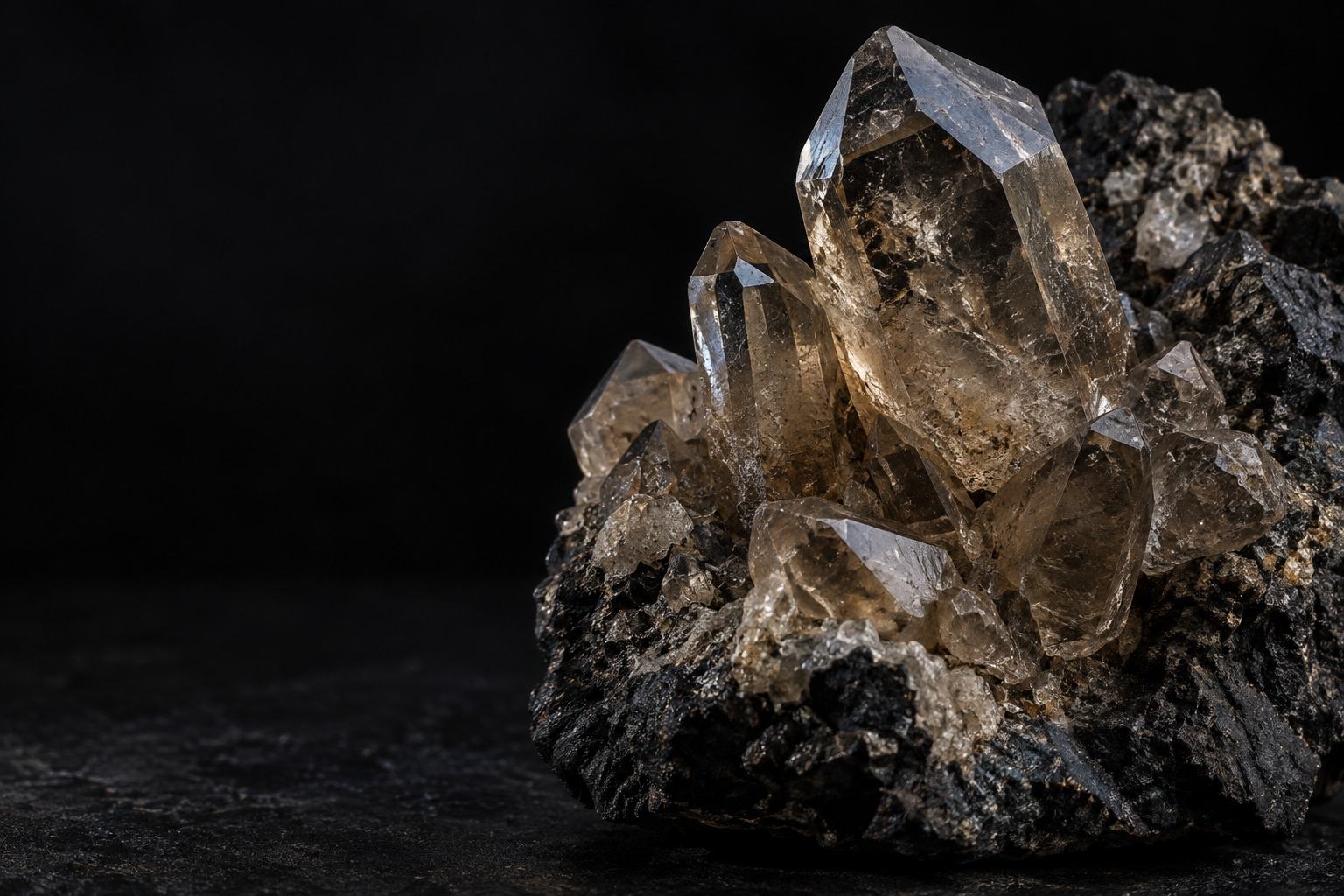
From a fracture in volcanic rock to the light above a city: discover the crystals that store, shape and carry Enkora’s energy.
Enter the resonance lab ↓ENERGY ATLAS / FOLLOW THE SOURCE
Hot rock. Moving water. Wind. Starlight. Enkora combines regional sources with storage and precise regulation. Follow one source from the landscape to useful work.
Hot rock, ceramics and suitable thermal fluids hold energy for heating or later conversion. They need insulation; useful electrical work still requires a temperature difference and a conversion machine.
Refined Tear assemblies accept compatible input at charging stations. Orientation, mounting and controlled loading matter. A reserve has a capacity, a discharge limit and losses.
Manufactured hydrogen carries energy spent producing it. Its lifting role in balloons is separate from burning it as fuel. Neither role makes it a primary energy source.
In a conventional plant, heat drives a steam engine or turbine, which drives a generator. In a Tear assembly, the fictional material releases stored energy through a controlled transduction system: changing mechanical strain couples to a piezoelectric element, electrodes collect charge, and regulation conditions the output.
Static pressure alone cannot provide continuous electrical power. Phonons describe mechanical excitations and transfer; they are not an inexhaustible fuel. Long-lived, useful storage in the Tears' internal states is the speculative material property.
Geothermal electricity · US Department of Energy ↗ · Hydrogen as a carrier · US Department of Energy ↗
MACHINES / ENERGY IN MOTION
A charged assembly can move energy from a stationary plant to a vehicle or a remote installation. Select a system, then follow its working cycle.
ENGINEERING SCHEMATIC / NOT TO SCALE
THE RETURN JOURNEY MATTERS
Power plant → charging station → tested assembly → vehicle or installation → depleted return → inspection and recharge.
The crystal moves energy; it does not replace the source. Charging time, thermal management, handling and maintenance shape the transport network.
Explore transportation on Tiåmåt →ENGINEERING / CONTROL IS NOT CAPACITY
A mineral becomes a dependable component through measurement, refinement and a controlled physical interface. A larger network demands coordination, not a magical source of extra power.
A natural geological crystal contains domains, defects, inclusions and stressed regions. Refinement selects useful material and manages its internal structure; removing every defect is not the same as improving every function.
The seat sets contact, alignment, preload and damping. It couples the mineral to the machine while instruments track its response. Removing the crystal changes those boundary conditions.
Assemblies are calibrated and tested before charging. Thermal drift, cracking and poor coupling can limit release. Isolation can interrupt a fault; a sink transfers energy to another reservoir or to the environment, rather than erasing it.
The diagrams explain energy paths, not measured performance. Tear energy density, industrial efficiency and vehicle range are not inferred from real laboratory experiments. The material's extraordinary storage and coordination remain part of the fiction.
01 / TUNE THE MATERIAL
A Tear responds to a compatible combination of vibration, light and physical conditions. Move the controls to see why an identical stimulus can produce very different results.
Adjust the frequency and phase.
Illustrative response model. Values are normalized; they are not measured frequencies, efficiencies or material properties.
Phonons describe collective lattice vibration. Photons carry light. Coupling allows a suitable mechanical stimulus to change optical response—and vice versa.
Macroscopic coherence means many regions preserve useful phase relationships. Alignment, geometry and mounting matter as much as the crystal itself.
Heat, strain, impurities and microfractures shift or degrade the response. Calibration must follow the material’s condition.
02 / ACCOUNT FOR EVERY UNIT
Charging requires a compatible energy input and a conversion path. Geothermal heat, for example, can drive an engine and generator before a station charges an assembly. Useful output draws down a finite reserve. Every conversion leaves losses.
ILLUSTRATIVE ENERGY LEDGER
Reserve capacity: 120 illustrative units. Losses include heat and unusable transfer.
The reserve is empty. Supply energy before drawing from it.
03 / FROM VEIN TO FUNCTION
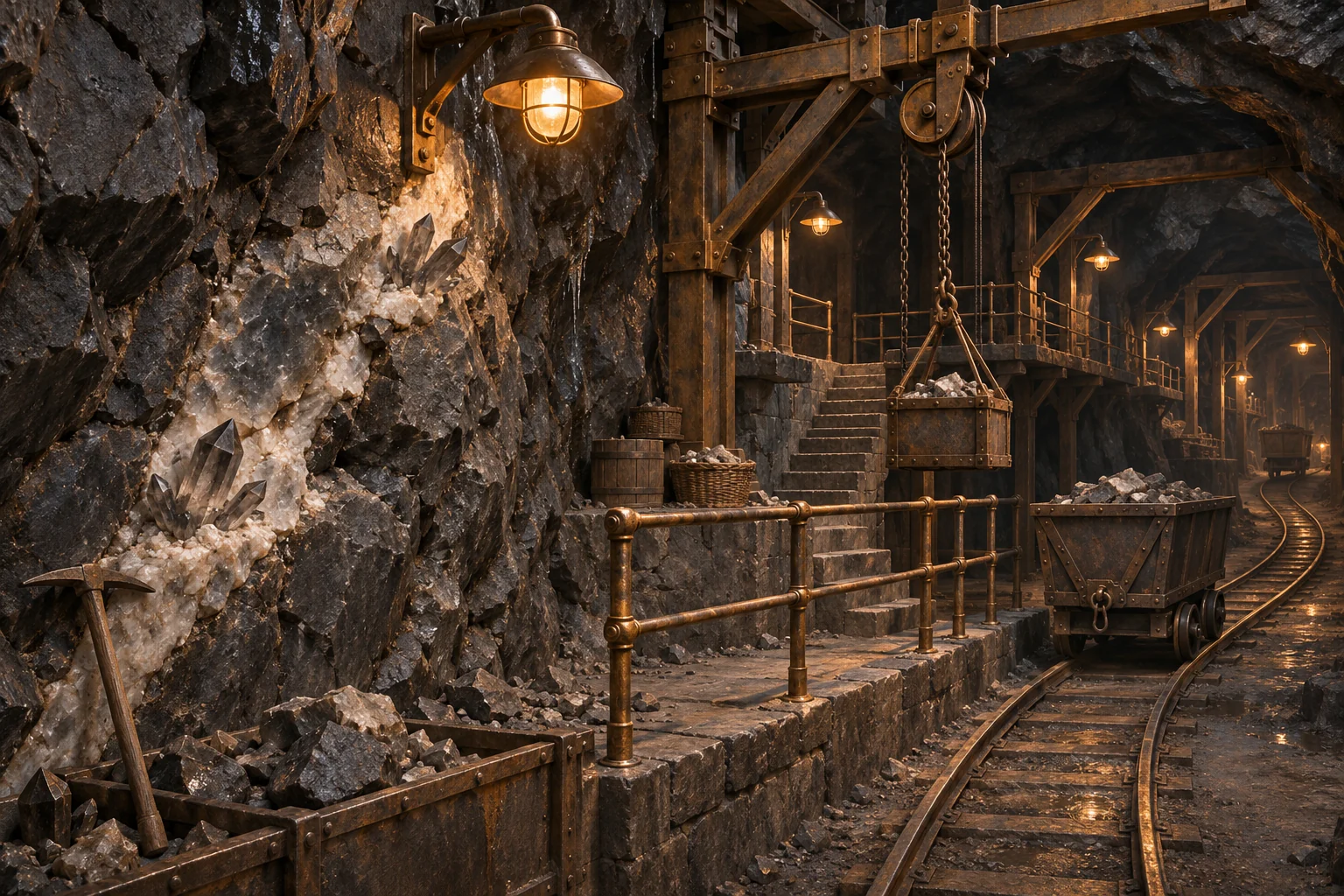
Pressure, heat, chemistry and deformation build Tears over geological time. Volcanic and hydrothermal systems concentrate their precursors into veins.
The Khur-Tarek Ridge links the Akdar-controlled Maw of Zarakh, within Zarakh / Qur’Gal, with competing eastern mineral fields. East of Zarakh, House Malurk controls the Maw of Dazhuk inside Dazhuk / Qur’Daq, Tarek’s principal Tear-extraction complex. Its deposits and processing routes give Tarek an independent source of Tears and leverage over Enkora’s energy network. Removing a crystal changes the vein’s mechanical boundaries. A compatible siliceous matrix supports the cavity’s response; it does not replace the removed crystal’s energy capacity.
04 / THE CONNECTED CITY
Vektor-1 regulates locally. Vektor-2 coordinates sectors and isolation. Explore how a physical break changes the routes available to a disturbance.
Both gates are open. All three parts share a physical transfer path.
Schematic topology demonstration, not a failure forecast. Compatibility, load, geometry, maintenance and timing determine a real outcome. Closing a gate here removes a route; it does not erase local danger.
A Vektor is assembled from refined Tears, a piezocrystalline seat, containment, orientation and tuning. Its number describes regulatory scale and function, not mineral purity. An ordinary city uses local and sector regulators; it does not require a central Vektor-3.
The Ishkar meter monitors residual electromagnetic emissions. Changes must be compared with a baseline and other instruments. A reading is evidence to interpret, not a shield or an automatic diagnosis.
05 / A CIVILIZATION OF APPLICATIONS
The surrounding machine determines what energy becomes. Select an application to follow its path.
06 / WHERE SCIENCE MEETS THE FICTION
Piezoelectric and optomechanical systems connect mechanical, electrical and optical behavior. Energy storage preserves input for later use, with conversion losses. These provide a physical vocabulary for the fictional material.
NIST · Sound, light and radio waves ↗US Department of Energy · Storage basics ↗The Tears’ combined properties, geological abundance and useful macroscopic coherence belong to Tiåmåt’s fictional physics. Real optomechanics does not establish the existence of this mineral.
Enkora’s scientists can build reliable tools while their deepest explanation remains incomplete. The Zar’Uk Order preserves calibration, classification and custody; knowledge depends on instruments, archives and people.
The interactive waveforms, relative tuning values, reserve capacity and conversion factors show how resonance and energy transfer behave. Their normalized units illustrate relationships rather than measured material properties.
07 / FOLLOW THE EVIDENCE
Real research reveals how structure shapes vibration. Explore the mechanisms that inspire the Tears, then open the studies behind them. Each connection is an analogy, not experimental evidence for Tiåmåt’s mineral.
MASS & STIFFNESS BENCH
Both traces cover the same interval. More cycles mean a higher frequency; wave height is held fixed for comparison.
Simple harmonic model: f / f₀ = √[(k / k₀) / (m / m₀)]. Assumes a single mode, small displacements and no damping. Slider ranges are teaching choices, not isotope abundances or a recipe for Tears.
Isotopes can change mass without changing the element. In a real crystal, bonding, geometry and many coupled modes also matter. Changing mass is not a source of energy.
2021 · DEFECT SPECTROSCOPY
Electron microscopy resolved changes in vibrational spectra close to a stacking fault in silicon carbide.
Connection to the fiction. Local structure matters: two regions of one crystal need not vibrate identically.
Where the analogy ends. This measures vibrational behavior. It does not demonstrate a high-capacity energy reservoir.
2024 · LOCALIZED MODES
Microscopy and calculations identified localized, confined and extended vibrational modes associated with a defect in gallium nitride.
Connection to the fiction. Different modes offer a useful analogy for the Tears’ varied internal responses.
Where the analogy ends. Localization alone establishes neither long-term storage nor a lossless material.
2023 · PHONONIC WAVEGUIDES
Numerical modeling explored frequency-selective sound transmission through engineered resonator arrays and defect channels.
Connection to the fiction. Geometry can select which vibrations pass, reflect or remain concentrated.
Where the analogy ends. These are designed acoustic structures, not natural crystals that power a city.
2020 · ENERGY CONTROL
A designed mechanical absorber was implemented and tested to reduce transient vibration across multiple modes.
Connection to the fiction. A regulator can redirect energy into a coupled subsystem for dissipation.
Where the analogy ends. An energy sink is not an energy source, and damping is not automatically recoverable storage.
2014 · THERMAL TRANSPORT
Molecular-dynamics simulations showed how strain and twin boundaries can change heat transport in a modeled film.
Connection to the fiction. Mounting and mechanical conditions can alter a material’s response.
Where the analogy ends. A change in thermal conductivity does not prove nuclear stabilization or unlimited power.
2020 · PHONON CONFINEMENT
A study of engineered mechanical modes explored phonon trapping through bound states in the continuum.
Connection to the fiction. Carefully structured resonators can suppress specific routes through which vibration escapes.
Where the analogy ends. This does not establish that crystal pores halt radioactive decay or store energy indefinitely.
A localized vibration, a routed wave and stored energy describe different things. Confinement can reduce particular escape routes; dissipation still matters. A useful reservoir also needs a charging mechanism, a retention time, a release mechanism and an energy budget.
The Tears combine those functions in a fictional geological material. Their composition, operating bands and performance cannot be inferred directly from these studies.
EXPLORE THE REGULATORS
Explore the three regulatory scales, the exceptional core of the Fauce, its safeguards and the story of the Contravektors.
Enter the interactive Vektor observatory →Explore solid-projectile acceleration and the thermal limits of Tear-powered machines.
Discover the weapons science →EARLY AQMORITA APPLICATIONS
Explore how early stone pyramids could connect solar collection, Tear reserves and local light or heat. Follow the proposed physical routes between chambers and selected columns.
Aqmorita pyramids → Akkad pyramids → Hakbiru pyramids →