The Akkad learned the early energy techniques of the Tears from Aqmorita travelers who settled among them. They adopted that knowledge while continuing to build in forms shaped by their own architectural traditions.
Ancient installations in the meridional Akkad lands preserve the earlier practice. Elsewhere, stone, metal, steam and calibrated Tears became parts of larger industrial systems.
Long before conquest joined the continents politically, a few Aqmorita crossed the seas through brief tidal windows. The relative positions of the four moons could make particular passages temporarily less hazardous. Many travelers died; a successful crossing did not promise a return.
Some remained in Akkad lands, became part of local communities and brought their skills and beliefs into everyday life. Among the knowledge they shared were techniques for extracting Tears, drawing useful energy from sunlight, storing charge and working with the mineral’s resonant response.
Akkad communities copied these early techniques. Their workshops later refined the material, improved its mounts and expanded its applications. That later industry grew from knowledge transmitted through contact and settlement.
Still working in the south
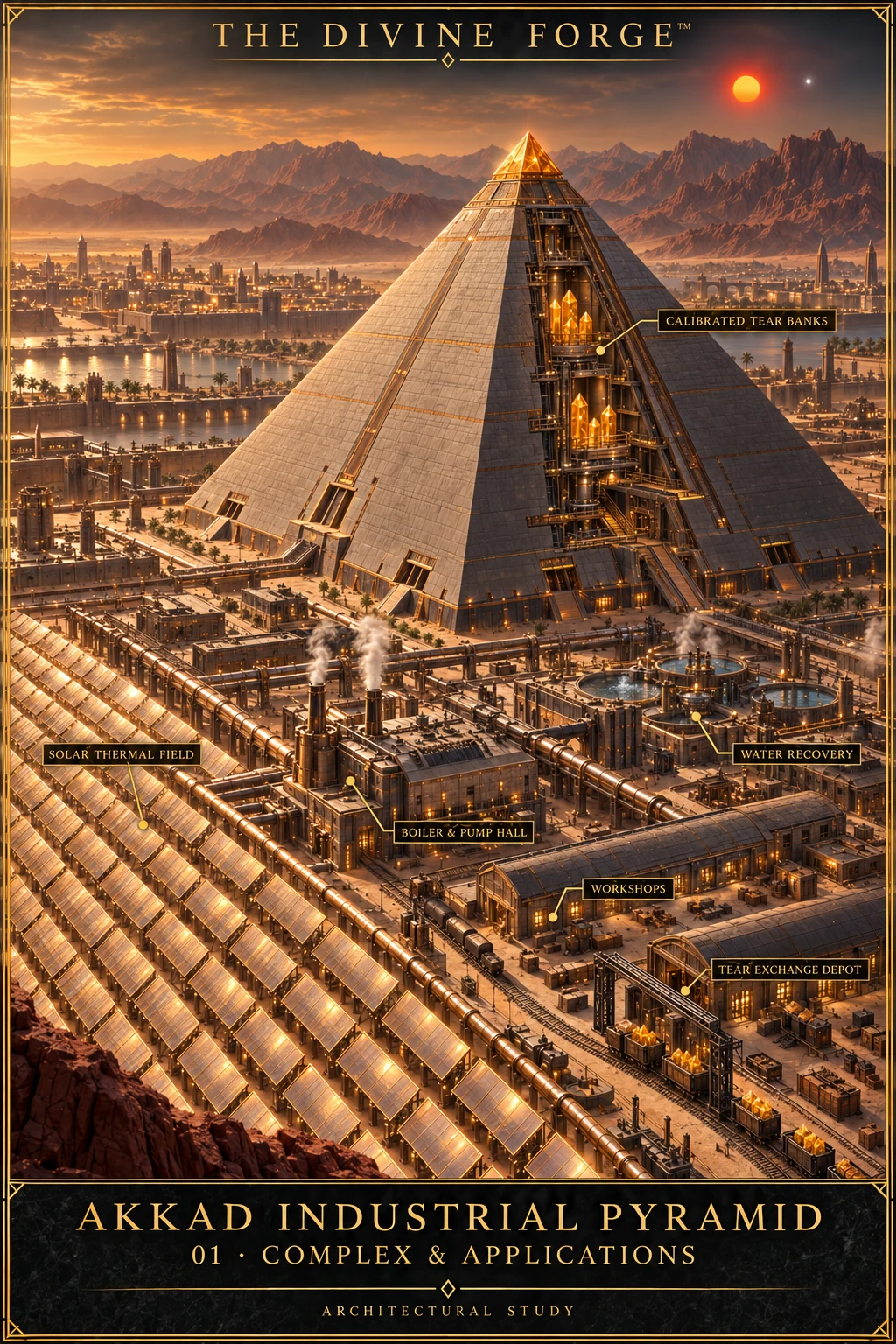
In older parts of the meridional Akkad continent, pyramids of the inherited tradition still stand and operate in a manner similar to their Aqmorita counterparts. These are an enduring part of the continent’s technical history, alongside later Akkad forms.
The stone-and-amber illustration represents this shared early tradition.
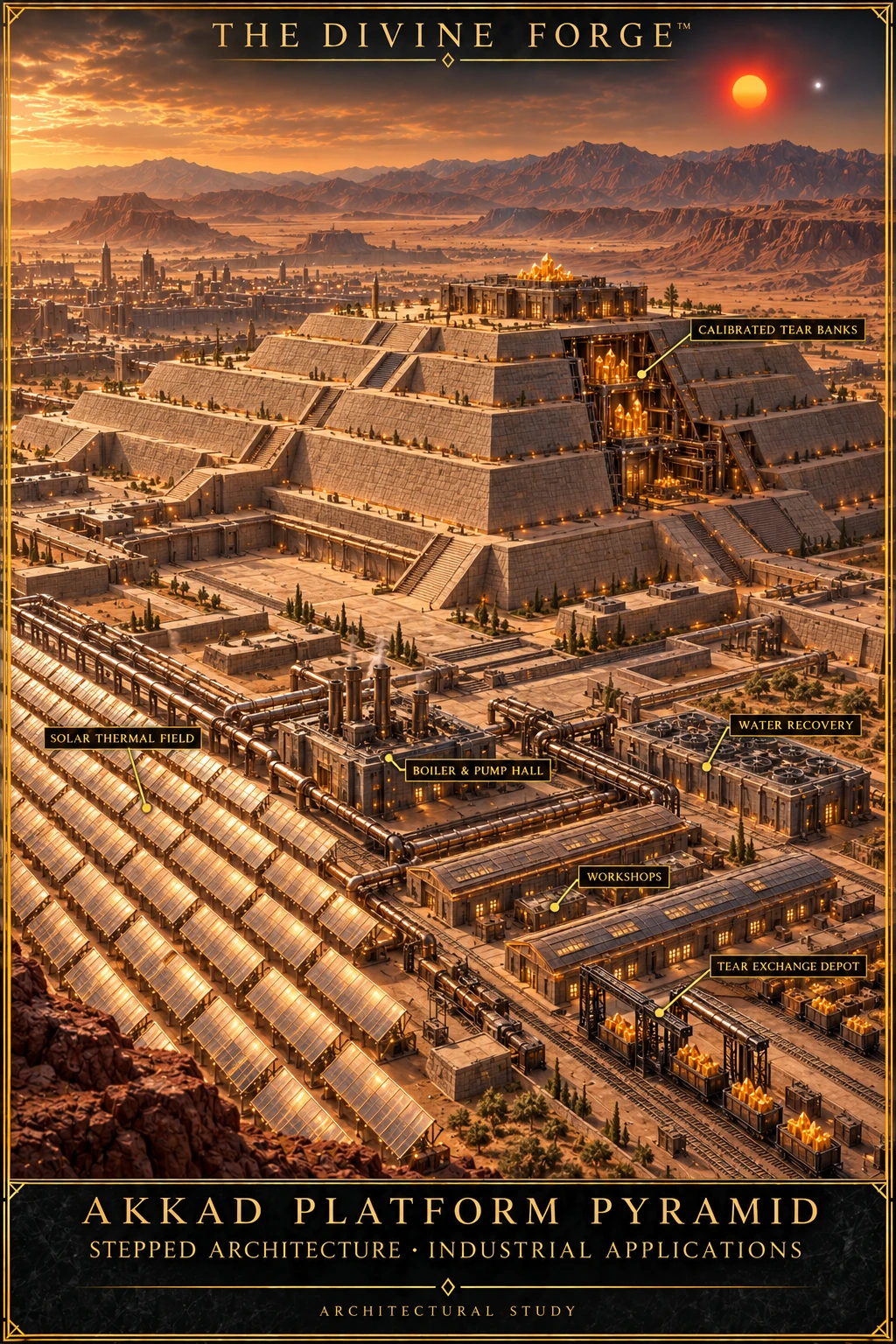
The Akkad retained their own ways of building as they adopted Aqmorita energy techniques. The following illustrations explore that continuity.
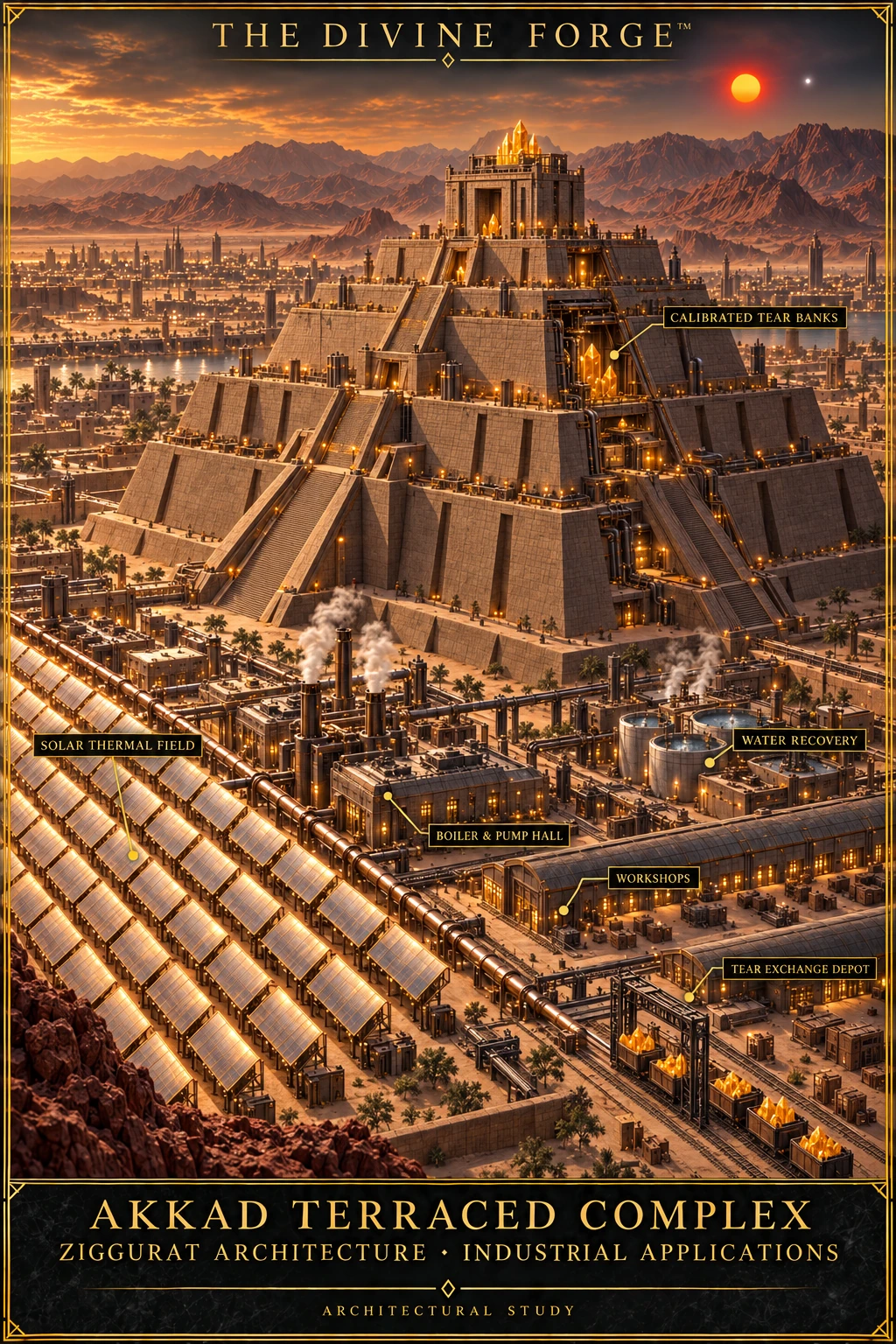
AKKAD CONSTRUCTION · TERRACES
A monument built in receding levels
Wide structural terraces support upper installations, stairs and service access. The industrial study places calibrated Tear assemblies within protected rooms and connects them to external collection, workshops and transport facilities.
What changes between forms?
Building geometry changes the arrangement of access, rooms, loads and equipment. The energy system still requires sources, conversion, compatible mounts, reserves and useful loads. A different silhouette does not automatically confer greater output.
View all architectural forms without using the selector
From a local installation to a connected energy economy.
The industrial expansion combines a larger supply of energy with more reproducible material preparation, controlled conversion and maintained distribution. Each installation must be matched to its available resources.
→→→→
01 / PHYSICAL SOURCES
A source large enough for the load
Takbiru supplies the dominant ordinary stellar heating. External reflectors concentrate radiation onto receivers for thermal collection. The amber apex remains part of the illustrated installation, but its small exposed area alone does not justify the entire industrial campus.
Enlarged sectional study. The illustrated circuit is conceptual; equipment dimensions and performance are not construction specifications.
Heat has several useful routes
Collected heat can go directly to a suitable process, enter thermal storage or drive a steam engine. Where electrical charging is required, a generator converts mechanical work into electrical input for the charging assembly. Direct use avoids conversions a particular task does not need.
Bulk storage and precise reserves
Rock, ceramics or suitable hot fluids can retain bulk heat. Selected Tears serve roles where controlled release, portability, compact reserves or stable delivery justify their preparation and maintenance.
Resonance needs a material interface
A refined Tear’s response depends on frequency, phase, orientation, temperature and mounting. Fitted seats maintain contact, pressure and damping. Protected connections couple compatible components to the machinery or other receiving pieces.
Three routes, three jobs
Thermal circuit: receivers, heat exchangers and process equipment.
Working-water circuit: boiler, steam engine, condenser and feed pump.
Tear network: mounted assemblies, protected connections, instruments and branch isolation.
Red, blue and gold identify those schematic routes in the study. Pipe color does not define a new mineral property.
04 / ENERGY PUT TO WORK
Applications of the Akkad complex
Applications vary with the available resources, equipment and needs of each installation.
WATER
Pumping
A motor drives a pump to raise existing water from a cistern, well or channel. Lift height and flow determine the required work.
Exhaust steam gives up heat, condenses and returns to the feed circuit. Recovery reduces demand for replacement water without eliminating leaks.
TRANSPORT
Energy exchange
Depots exchange charged and depleted Tear assemblies and provide water, inspection and mechanical service for transport.
SETTLEMENTS
Light & ventilation
Maintained branches serve local lighting, air circulation and other loads within the available supply.
CONTROL
Reserve & isolation
Separated banks and disconnectable branches allow maintenance and help limit disturbances spreading through a connected system.
The six equipment panels are separate enlargements. Their scale should not be read as the equipment’s proportion within a monument.
05 / ONE CONTINENT, DIFFERENT CONDITIONS
Southern inheritance. Northern demands.
Ancient southern installations coexist with Akkad pyramids across arid northern lands, temperate territories and glacial regions. Resource extraction has also damaged these lands. Their architecture belongs to a continent with changing conditions and unevenly surviving infrastructure.
SOUTHERN HERITAGE
Meridional legacy
Older sites preserve Aqmorita-derived practice. Their continued use is part of the Akkad continent’s history of settlement and shared knowledge.
PROPOSED ADAPTATION
Arid north
Dust protection, accessible collector cleaning, heat rejection and water recovery would be essential priorities where solar collection is viable.
PROPOSED ADAPTATION
Temperate lands
A regional installation could combine sources according to local availability and distribute heat or power toward workshops and settlements.
PROPOSED ADAPTATION
Glacial regions
Insulation, freeze protection and dependable reserves become central. Low-light periods require adequate stored supply or another available source.
Where geothermal heat is available
Hot rock and hydrothermal fluids can provide direct heat or feed a conversion plant. Geological conditions determine whether this option exists. Neither a cold climate nor a pyramid establishes a usable geothermal resource by itself.
What extraction leaves behind
Resource extraction has damaged lands across the Akkad continent. Surviving installations stand within territories shaped by the demands of mines, water supply and industry.
06 / ENGINEERING LIMITS
Precision depends on upkeep.
Stone supports; mounts control
Broad foundations and substantial masonry support the building. Localized interfaces control the active material. Stone’s thermal mass slows temperature changes; it does not replace heat rejection, insulation or ventilation.
Water returns; heat must leave
A condenser recovers water only by rejecting heat to a cooler environment. Dry cooling can reduce water loss where feasible, but cooling performance depends on ambient conditions and equipment size.
Isolation limits a fault
Fracture, changing contact or thermal drift can destabilize a formerly compatible connection. Disconnectable branches and accessible equipment support inspection and material repair.
Capacity remains measurable
Collection area, input conditions, reserve, losses and demand determine operating duration. The illustrations establish no exact power rating, storage capacity or transmission range.
07 / REAL SCIENCE & THE MATERIAL OF TIÅMÅT
Scientific foundations
Solar heat & storage
Real solar-thermal systems use reflectors, receivers, heat-transfer fluids and storage. Direct and indirect arrangements can separate collecting and storage fluids with heat exchangers.
Laboratory piezo-optomechanical devices couple optical, acoustic and radio-frequency signals. This supports the language of transduction and compatible modes, not an industrial power rating for a natural mineral.
Geothermal installations can use underground heat directly or convert it into electricity. Resource quality and local geology govern the usable arrangement.
The Tears’ natural combination of storage, coupling and useful macroscopic coherence follows Tiåmåt’s established material rules. Specific pyramid hardware remains an architectural study.
Explore another architectural tradition: terraces for stellar and lunar observation, records of crops and tides, and small Tear installations for local warmth.