Its original home was a K-type star associated with Gaia–Sausage–Enceladus. The galaxy’s ancient absorption into the Milky Way and the planet’s later ejection are separate events.
BEFORE THE ADOPTED SUNS
An older home. An older biosphere.
Tiåmåt formed around its original K-type star. Life arose in its primordial oceans, supported by geothermal vents and mineral-rich chemical gradients. Its biological history began before its encounter with Takbiru–Takmat.
The planet’s age is not the age of the present binary system.
Tiåmåt’s later frozen passage · artist’s impressionHow can a planet change stars?
A close gravitational encounter can transfer enough energy to unbind a planet from its original star. Later capture requires another exchange of energy: a simple flyby of an isolated, static point mass cannot permanently bind an incoming planet. Multiple bodies or a changing environment can make capture possible.
Tiåmåt’s story uses rare encounters of this kind. The precise encounter geometry, approach speed, and survival of its satellite system require a dedicated dynamical model; the orbital explorer below does not simulate the capture itself.
02 / INTERACTIVE ORBIT LAB
One orbit. Generations of change.
Move Tiåmåt through one revolution. Watch distance, orbital speed, and incoming starlight change together. The planet circles both stars, not either one alone.
Top-down schematic · ellipse compressed vertically for display · stars and planet enlarged
NEAREST APPROACH / PERIASTRON
AU from the center of mass
Earth’s incoming starlight
km/s orbital speed
Southern summer aligns with closest approach: distance and axial orientation reinforce the southern warm season.
Incoming energy is not surface temperature. Clouds, atmosphere, ice, oceans, and thermal lag shape the actual climate.
The inverse-square law turns a modest change in distance into a large change in incoming energy.
What the explorer calculates
This is an idealized two-body model of the planet moving around the binary’s combined mass. Reference inputs: semimajor axis 324 AU; eccentricity 0.20; combined stellar mass approximately 19.4 solar masses; Takbiru luminosity approximately 120,000 solar luminosities. Takmat’s ordinary contribution to planetary heating is neglected.
The model solves Kepler’s equation for position at equal time intervals, uses the vis-viva equation for orbital speed, and calculates irradiance as luminosity divided by distance squared. These rounded values give an orbital period of about 1,324 Earth years. It is an educational model of the fictional setting, not a simulation of capture, long-term stability, weather, or biological survival.
AU means astronomical unit: approximately the Earth–Sun distance. “Earth’s incoming starlight” compares top-of-atmosphere irradiance with sunlight at Earth’s orbit.
03 / THE CLIMATE ENGINE
Light changes quickly. Oceans answer slowly.
Four processes combine to shape Tiåmåt’s environment. The long orbital seasons are distinct from the civil calendar.
01
An eccentric orbit
Distance varies from about 259 to 389 AU. Under the same stellar luminosity, the nearest point receives 2.25 times as much energy as the farthest.
02
A tilted world
An axial tilt of about 40° creates strong hemispheric contrasts. Southern summer coincides with closest approach; northern summer occurs near the farthest point.
03
Thermal memory
Water, ice, rock, and atmosphere store and redistribute heat. Maximum surface temperatures can lag behind maximum incoming energy.
04
An evolving sun
Takbiru’s ongoing evolution adds a longer-term pressure. The retreat of seas and glaciers is not simply reversed by the next cooler phase of the orbit.
One civil year follows Eak’s 216-Cycle period. The approximately 1,324-Earth-year planetary orbit belongs to a different scale of time.
04 / THE ADOPTED SUNS
Two stars. A separate ancestry.
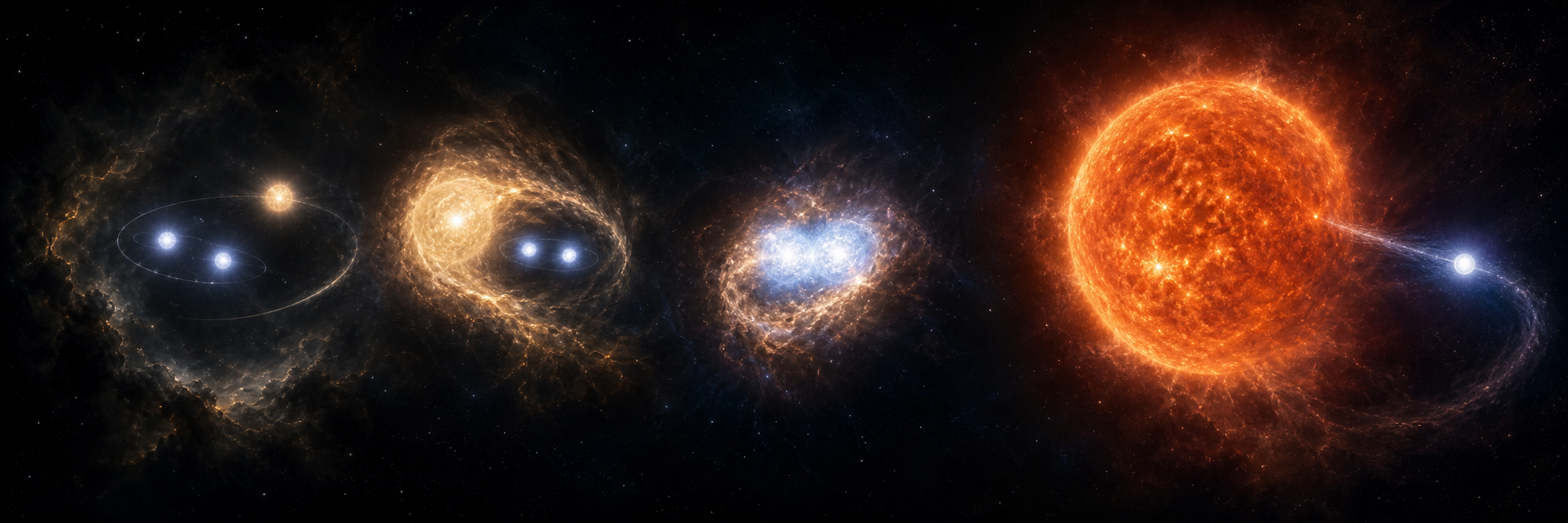
The binary descends from a hierarchical triple. This stellar family tree describes the origins of Takbiru and Takmat—not the birthplace of Tiåmåt.
Evolutionary schematic · stages are not drawn to a shared timescale
THE DOMINANT SOURCE OF LIGHT
Takbiru
A massive, rejuvenated merger product that evolved into a red supergiant. At approximately eighteen solar masses, it dominates the planet’s illumination and heating.
Its expansion, changing luminosity, pulsations, and mass loss can be studied through observations accumulated across generations.
THE FAINT COMPANION
Takmat
The compact remnant of the former outer star. Small and faint beside Takbiru, it is often difficult to separate from the brighter star’s glare and surrounding wind.
Observers can record unusual changes and traces of activity. During Book One, the significance of those signals remains unresolved.
At planetary distances, the two stars form a compact central system.Approximately 20 AU apart · roughly 20.3 Earth years per binary orbit
05 / PHYSICS BEHIND THE FICTION
Real mechanisms. A fictional history.
Research supports the underlying processes. It does not establish that this exact sequence, orbit, or biological outcome occurred in nature.
Illustrations are artistic interpretations. Diagrams distinguish the adopted system’s ancestry from Tiåmåt’s earlier history. Long-term capture stability and the survival of its moons and biosphere remain beyond the scope of this interactive model.