- Where it is used
- What it cannot replace
THE DIVINE FORGE™ / RESONANT ENGINEERING
VEKTOR-3
The architecture
of control.
One exceptional regulator holds a dangerous network in balance. Its power lies in what it can govern.
Enter the system ↓THE FAUCE OF ZARAKH / ARTISTIC INTERPRETATION
THE CENTRAL DISTINCTION
A Tear is the material.
A Vektor is the engineered system.
INSIDE UNIT SIX / THE FAUCE OF ZARAKH
A contained core.
A network held in balance.
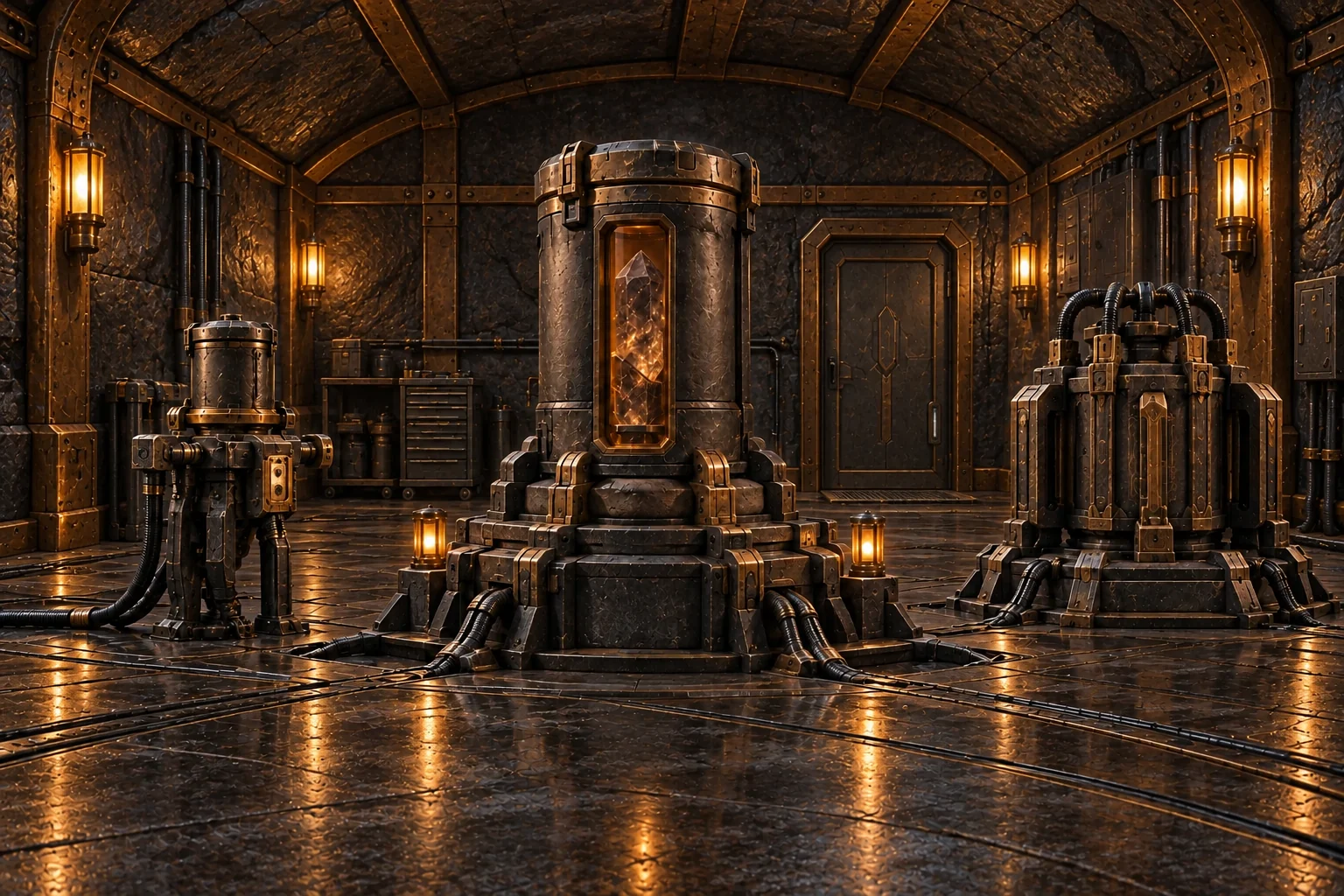
The custody vault lies within the Fauce of Zarakh, the mining complex inside the volcano known to the Aqmorita as Qur’Gal. Vektor-3 regulates the deep network during extraction; it does not eliminate every geological hazard.
The crystal is smaller than its containment assembly. In service, the assembly is coupled to a fixed seat; in transit, a mobile cradle preserves orientation, isolation and damping. A closed container alone does not guarantee stability.
01 / THREE SCALES OF RESPONSIBILITY
Local stability.
Sector containment.
Collective balance.
The numbers describe regulatory scope and function. They do not form a ladder of mineral purity, and they do not mean three sizes of battery. Select a level to see its role.
Vektor-3 does not feed Vektor-2 and Vektor-1 in sequence or operate every smaller regulator individually. It reduces collective loads that would otherwise reach them. Ordinary cities can use local and sector regulation without possessing a Vektor-3.
02 / MATERIAL + MOUNTING + MEASUREMENT
A crystal alone
is not the machine.
Vektor-3 is built around an exceptional refined Tear. Its core, seat, containment, instruments and routes for dissipating energy must work together.
FROM MATERIAL TO SERVICE
Implementation is a continuing responsibility.
→→→
03 / AN INTERACTIVE ANALOGY
One disturbance.
Several kinds of motion.
A complex network has more than one vibrational pattern. Compare a local regulator's limited scope with the broader role of Vektor-3.
RESPONSE BENCHVektor-3
— Incoming disturbance— Remaining response
A sink must transfer energy somewhere. It cannot absorb unlimited energy forever.
A qualitative teaching model with invented response coefficients. It illustrates differences in scope, not operating frequencies, tested efficiencies or a prediction of failure. Sector isolation is explored below.
04 / PROTECTION IN LAYERS
Guard the chamber.
Protect the conditions.
Security protects access. Engineering protects the physical state. Neither can replace the other.
CUSTODY
The vault is part
of the system.
At Unit Six, Ka'Ruk guards protect access while a Zar'Uk specialist supervises the regulator. The chamber maintains controlled mechanical, thermal and resonant conditions around the mounted core.
Records, instrument baselines and handovers help distinguish an ordinary fluctuation from a developing problem.
EXPLORE THE DEFENSES
These are complementary safeguards. The display describes their roles; it does not calculate a safety guarantee.
Compare with a baseline.
A single reading is evidence to interpret. Thermal drift, changed vibration and residual electromagnetic emissions require context and independent checks.
Interrupt a transfer path.
Isolating a sector can limit a disturbance's reach. It may also interrupt water, lighting, heating or other essential services.
Dormant is not harmless.
A contained or stabilized assembly can retain energy. Safe custody continues after visible activity subsides.
05 / SINGULAR IN BOOK ONE
01One intact regulator.
One intact regulator.
An exceptional conjunction.
The Fauce of Zarakh holds the only intact Vektor-3 of this scale in Book One. It is not a naturally occurring object dug out of the rock already complete.
The material
An exceptional refined Tear must support the required collective response. An ordinary specimen cannot simply be renamed Vektor-3.
The architecture
The core's useful behavior depends on the seat, geometry, containment, instruments and energy-transfer paths working as one assembly.
The knowledge
Characterization and calibration connect that particular material to its particular network. Possessing a fragment does not reproduce the whole system.
“Only one” describes the established situation in Book One. It is not a claim that the laws of Tiåmåt forbid another from ever being developed.
THE MATERIAL / FROM ATOMS TO INFRASTRUCTURE
Where physics ends.
Where Tiåmåt begins.
Solid-state physics explains how a crystal can respond to stress, electric fields and vibration. The Tears extend those behaviors into an exceptional fictional material. No cited experiment demonstrates a natural crystal with the storage capacity or destructive reach described in the novel.
01 · Piezoelectric coupling
In suitable materials, mechanical deformation and electrical response are coupled. Electrical input can also produce deformation. This is energy conversion, not energy creation.
In Tiåmåt: this relationship provides an analogy for the crystal’s interaction with its seat, instruments and mechanical surroundings. It does not establish an unlimited source of heat or electricity.
02 · Domains and their boundaries
Ferroelectric materials can contain regions with different polarization orientations. Domain boundaries can affect electrical transport and material response.
In Tiåmåt: internal organization helps explain why two specimens, or the same specimen in different mounting conditions, need not behave identically. An exceptional mineral at industrial scale remains fictional.
Research: controllable conductance at domain walls ↗03 · Resonance and nonlinear damping
Physically coupled systems can exchange vibrational energy. A nonlinear absorber can respond differently as motion changes and dissipate energy from multiple modes. It cannot remove unlimited energy without losses or an outgoing dissipation path.
In Tiåmåt: this is an analogy for the original Vektor-3’s stabilizing role. The fictional network must still possess a physical route for energy transfer; shared names or matching symbols create no connection.
Research: experimental multimodal vibration mitigation ↗04 · Metastability and finite reserves
A metastable configuration can persist because a barrier separates it from a lower-energy state. Metastability alone says nothing about a useful storage capacity, charging efficiency or retention time.
In Tiåmåt: persistent internal configurations help frame finite storage and changes of response. The exceptional energy density and controllability of the Tears are fictional properties, not deductions from the word “metastable.”
05 · Phonons and the quantum scale
Quantum mechanics underlies electronic states, bonding and lattice vibrations. Phonons are quanta of collective lattice vibration—not pellets of fuel trapped inside a crystal. Many large-scale vibration effects can be described with classical mechanics.
Engineered structures can confine particular vibrational modes and reduce some escape routes. This does not establish indefinite retention, a high-capacity battery or a crystal-powered city.
Research: observation of phonon trapping ↗Coherence is not entanglement.
Organized vibrations can have related phases without forming a quantum communication channel. The material does not provide instantaneous communication, no energy from the vacuum and no collapse of a quantum wavefunction that destroys buildings.
The microscopic vocabulary helps describe the material. It does not by itself explain the scale of a catastrophe.
07 / THE SCIENTIFIC BOUNDARY
A grounded vocabulary.
A fictional material.
Physical principles
Resonance, damping, energy conservation and the need to dissipate heat provide the framework. Regulation changes the behavior of energy; it does not create a new supply.
The fictional extrapolation
The Tears combine exceptional retention, transduction and coherent interactions in a naturally formed mineral at industrial scales. Vektor-3 belongs to that fictional extension.
What the displays mean
The interactive models illustrate relationships and responsibilities. They supply no canonical performance measurements, construction specifications or real-world weapon design.