
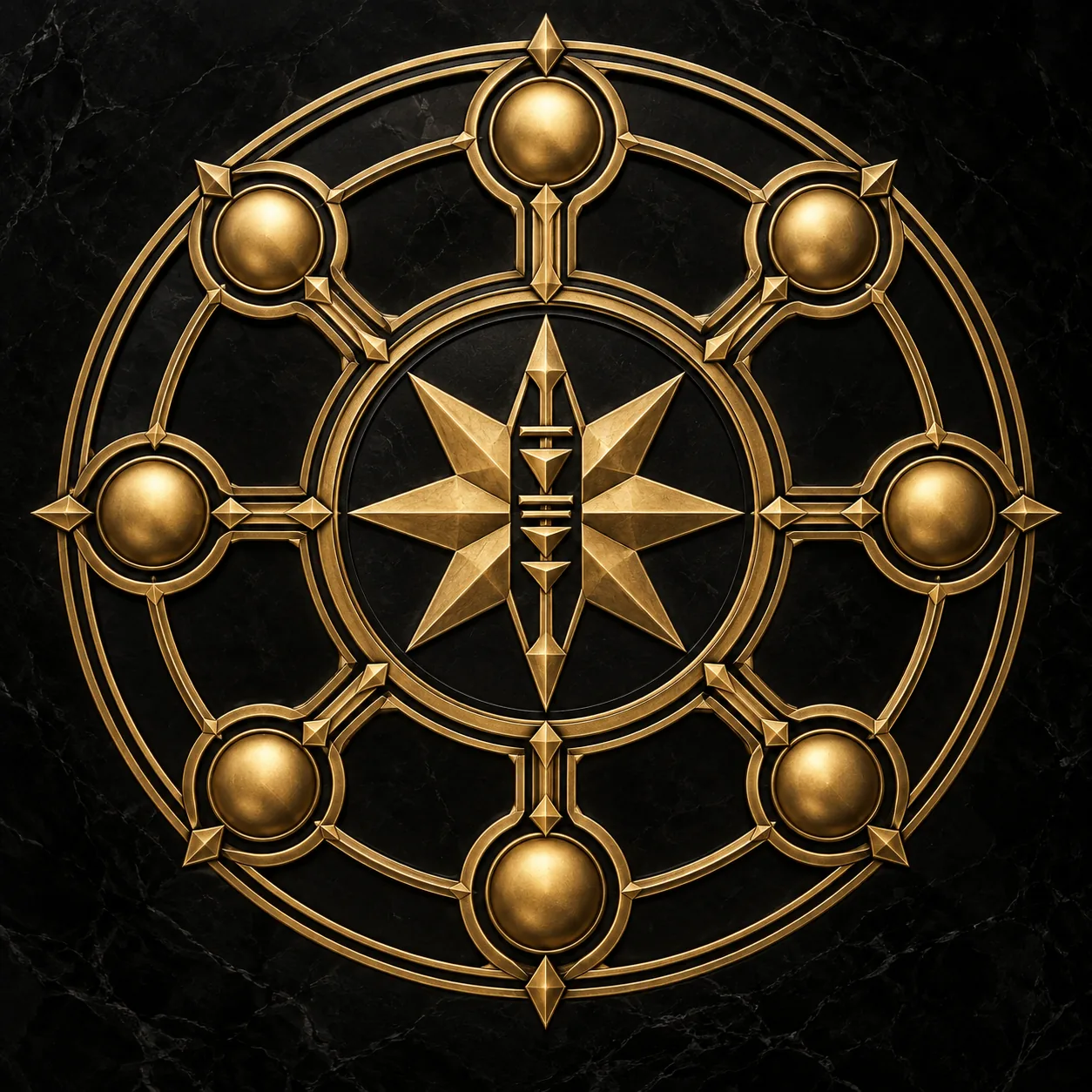
Kal-Muzar Official emblem
Kal-Muzar · Emblems
Political union
Eight Domains bind their political strength together without erasing the identities of the Houses within them.
The Kal-Muzar Enkuru is a political union of eight sovereign Domains, containing many Major and Minor Houses. Its authority operates through their pact, shared institutions and connected territories; it does not extend automatically over the entire Akkad continent or all of Tiåmåt.
Regents represent their Domains in the Council. Minor Houses retain local authority while their political representation passes through the greater hierarchy.
The eight orbs in the institutional language of the Kal-Muzar represent its eight Domains. A symbol of the union identifies a common institution; a House emblem identifies a particular lineage.
Norek Akdar is ruler of House Akdar, Regent of Kharet and Supreme Arbiter of the Kal-Muzar. These remain distinct offices, each with its own institutional meaning.
Before the union, sovereign Houses governed their own lands, laws, forces and religious traditions. Around twenty Houses built a Resource Cartel to negotiate water, Tears, food, routes, reserves and transport security. Economic agreements alone could not govern the crises that followed.
Scientific evidence of planetary deterioration, growing scarcity and the wars surrounding Gray Day made permanent cooperation urgent. Approximately eleven Earth years of conferences, emergency coordination, war, armistices and negotiation led to the ratification of the Kal-Muzar.
Each of the eight Domains appoints one Regent and holds one ordinary Council vote. A House does not receive an additional vote simply because it is powerful. Ereshkigal presides as High Voice without an ordinary vote. The Supreme Arbiter retains a Regent’s vote and may cast a second vote only after a four-to-four tie.
The Council coordinates shared resources, scientific standards, infrastructure, route security, inter-Domain disputes, common defense and planetary emergencies. Its members retain internal governments, laws, successions, traditions, religious practices and much of their armed strength.
Enkora is the Akkad empire and political order created through conquest, not the name of a natural continent or joined landmass. Its networks link the Akkad homeland with conquered territories and peoples of the eastern Hakbiru–Aqmorita continent. The imperial order contains distinct Domains and Houses; the Kal-Muzar coordinates their shared authority without erasing their jurisdictions. The Hakbiru retain their own territorial autonomy and diplomatic relationships; neither the Hakbiru nor the Aqmorita hold an additional ordinary founding seat.
Outside the pact, many Akkad Houses and Domains maintain independent political orders and beliefs. Natural disasters and the Burning Sky have devastated the lands of many such powers, bringing them into conflict with the Kal-Muzar. The union’s reach must be distinguished from the wider world in which it operates.
Kal-Muzar · Emblems
Kal-Muzar · Banners
Kal-Muzar · Banners
Kal-Muzar · Banners
Kal-Muzar · Seals
Kal-Muzar · Emblems
Kal-Muzar · Markings
Kal-Muzar · Insignia
Authority & its limits
The Kal-Muzar Enkuru is commonly called the Mandate. From its seat in Esh’Kharet, it gives permanent institutional form to agreements among the eight Domains. Its claim is that water, energy, scientific knowledge, supply routes and common defense must survive rivalries that no individual House can settle alone.
Its decisions bind its members through the pact. A Regent must build support in the Council to change a common decision; sovereignty does not make shared obligations optional. Outside the union, authority depends on treaties, negotiated access, territorial control and the capacity to enforce an agreement.
The Mandate protects the systems on which its members depend: scientific archives and research, standards for Tears and energy, strategic reserves, water and food supply, inter-Domain infrastructure, routes and common defense. It arbitrates disputes and coordinates responses to environmental emergencies.
Common projects require contributions of materials, labor, transport, access and financing, channeled through Domains and Houses. Allocation is political: a reserve, conduit, workshop or research program competes for support. The union does not operate a single uniform tax system over every inhabitant of Enkora.
Power lies in access to sources, extraction rights, refining, storage, conduits, depots, passes, transport and distribution. Controlling a station or a water conduit can compel negotiations far beyond the territory that contains it. Akkad networks control major collection and distribution systems, but not all water on Tiåmåt; no House owns every vein of Tears.
Territorial armies remain with Domains and Houses. Common defense coordinates them without turning every force into one permanent army. Ka’Ruk, the Custodians of Sciences and local guards have distinct missions and jurisdictions: authority to escort Tears is not general authority to govern every territory crossed.
The pact can preserve shared systems while leaving unequal systems of labor and legal status intact. Its dependence on Hakbiru water and knowledge, and on Aqmorita labor and expertise, does not translate into equal territorial representation. Its defense of civilization therefore coexists with disputes over whose freedom, safety and resources that civilization protects.
The Mandate inherited a world shaped by displacement, conquest and liberation. Begin with the divided Hakbiru–Aqmorita continent to understand the history beneath its treaties and resource networks.
Explore the peoples and their earlier history →
Ak-Malurk did not inherit Tarek peacefully. He broke with Akdar during the wars preceding the formation of the Kal-Muzar, conquered Tarek, destroyed its former ruling House, and seized control of the territory and its mineral infrastructure. His rule remained morally disputed, particularly by Norek Akdar, but the founders of the Kal-Muzar chose to recognize Tarek as one of the eight Domains because excluding it would have prolonged the war and left a powerful, resource-rich territory outside the new political order. The compromise deliberately separated recognition of the Domain from approval of its conqueror. The seat in the Kal-Muzar belonged to Tarek itself, not to House Malurk. Because Ak-Malurk controlled Tarek, he was permitted to occupy that seat and represent the Domain, even though the Kal-Muzar never declared his conquest or the destruction of the previous ruling House morally legitimate.