Heksaruk
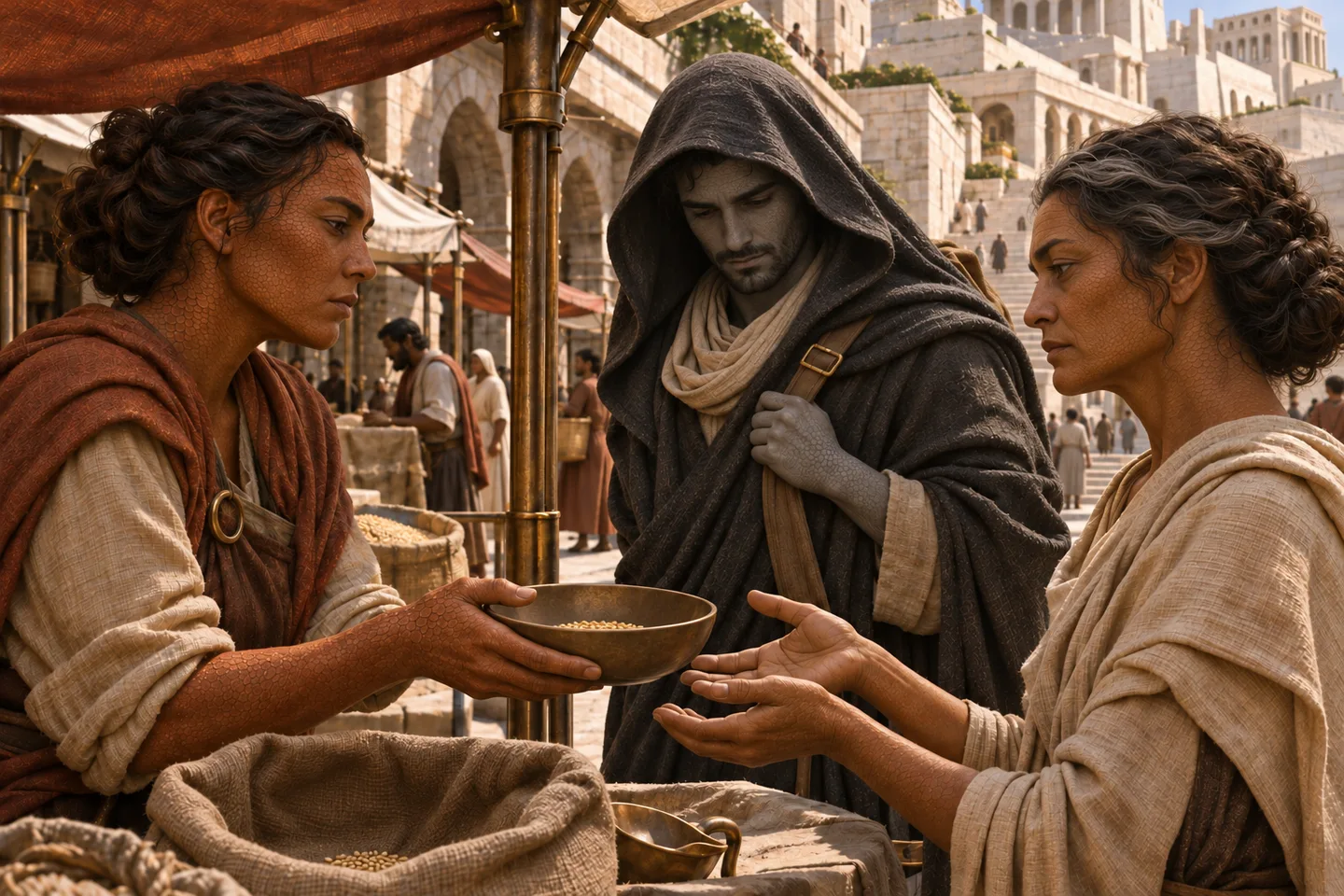
Heksaruk are generally accepted and can belong to Houses, cities and royal families.
TIÅMÅT / PEOPLES & CULTURES
Species, community, House, territory, occupation and legal standing overlap. Enkora’s cultures grow through those relationships; ancestry alone does not determine belief, loyalty or belonging.
The glacial north links the care of water with the care of memory. Measuring ice, preserving routes and keeping flow records connect knowledge to responsibility across generations. Heridû and the Libraries of Ice belong to this tradition of continuity.
The Kal-Thurim and the Great Guardian articulate a political order without making every monastery, archive or community an identical branch of government. Water custodians, scientists, religious groups, free northern communities and Hakbiru residents of Akkad cities have distinct priorities.
Exchange sustains food, science and diplomacy while raising fears of dependency. Northern influence rests on water, records, routes and negotiation; it does not create additional ordinary Kal-Muzar seats.
Hakbiru traditions ↗Calderas, caves, plateaus and hidden aquifers separate communities as well as sustaining them. Kinship, adoption, knowledge of wells and protection of routes organize local authority without one state governing every settlement.
Free communities, enslaved miners, manumitted residents, merchants, religious groups and resistance movements face different choices. Voq’Qur does not speak for them all. The same crystal can be sacred matter, a traded mineral or the object of forced extraction.
Songs of the Caldera carry memory, observation and rhythm through oral transmission. Their discipline is not diminished because the record is a voice rather than a House archive. Revealing a hidden source or betraying a refuge can endanger a community.
Aqmorita / Aqmo traditions ↗Houses connect inheritance, work, protection, reputation and obligations. City, frontier, profession and generation create differences within Akkad life. A scientific tradition or a conservative doctrine cannot represent every member of the civilization.
Capital institutions bring people together without removing unequal access. Smaller Houses can retain names, records and internal leadership while depending on larger powers. The eight Kal-Muzar Domains are only part of the wider Akkad world.
Houses & political relationships ↗Heksaruk and Hektrew are two hybrid lineages of Akkad and Hakbiru ancestry. Their place in society differs.
Heksaruk are generally accepted and can belong to Houses, cities and royal families.
Hektrew are marginalized in Tiåmåt’s society.
Upbringing and protection extend belonging beyond biological descent. Families and communities carry these responsibilities in different ways.
Kurna, Hurna and Qurna name one cereal. Zarakh and Qur’Gal name one volcano. Bhagirath, Alaknanda and Devpraq name the great river after Gaumukh. A word identifies a place or resource while also carrying the speaker’s memory.
Knowledge moves between songs, routes, workshops, libraries and laboratories. Cooperation requires listening across those forms. Appropriation begins when a result is taken while the people who preserved it are erased.
REAL-WORLD CONNECTIONS
These sources explain the real physical or social principles discussed here. Tiåmåt’s peoples, places and institutions belong to the fictional world.