DOMAIN 03 / 08 · THE KAL-MUZAR ENKURU
Tarek.
Rock, fire & sovereignty.
The volcanic mining frontier
One of the great territorial and mineral powers of the Kal-Muzar, Tarek extends across the volcanic Khur-Tarek system. Ak-Malurk’s crown rests on conquest, a major army and Tear-producing districts that challenge Kharet’s influence.
Explore the Domain ↓A SOVEREIGN MEMBER OF THE UNION
A power with its own territory.
Cresta Khur-Tarek
Ak-Malurk the Gray
One ordinary vote
Tarek maintains its own territorial authority, army and political interests. Its Houses preserve their identities within the Domain. Membership in the Kal-Muzar joins those interests to a common mandate for resources, science, routes and defense.
THE KING AND THE COUNCIL SEAT
Ak-Malurk the Gray
Territorial ruler · Regent in the Kal-Muzar
Regent of Tarek and head of House Malurk, Ak-Malurk weighs regional interests against the demands of cooperation. His rivalry with Norek is part of a political landscape in which agreement does not erase competing loyalties. The sovereignty of Tarek remains central to his judgment.
As king of his ruling House and territorial ruler, he exercises authority within Tarek. As Regent, he represents the Domain’s one ordinary vote in the Kal-Muzar Enkuru. The council office does not replace the Domain’s internal government.
House Malurk retains its lineage and House symbols, distinct from the territorial seal and military standard.
Explore the character ↗THE CONQUEST AND ITS INHERITANCE
How Malurk took the crown.
From House lord to conqueror
Before he ruled Tarek, Ak-Malurk headed a lesser House and rose through military command. He broke with House Akdar during the wars preceding the formation of the Kal-Muzar, amid fractured alliances and emergency coalitions remembered around Gray Day. While the great powers fought on several fronts, he turned his forces toward a territorial crown.
Malurk conquered Tarek and destroyed its ruling House. The old sovereign, Reshad Tarek, and members of the ruling family were killed. The violence sought to extinguish rival hereditary claims as well as defeat an army. House Malurk took control of the Domain’s military approaches and mineral wealth, and its lord became king.
A territory the new order could not ignore
Norek Akdar opposed recognizing the conqueror. Ereshkigal Kishkur argued that excluding a territory Malurk already controlled would prolong the conflict and leave a powerful enemy outside the settlement. The compromise admitted Tarek to the Kal-Muzar without declaring the destruction of its former dynasty just.
The seat belonged to Tarek as a Domain, not to House Malurk. Because Ak-Malurk controlled Tarek, he was permitted to occupy that seat and represent the territory. Recognition neither declared his conquest morally legitimate nor justified the destruction of the former ruling House. It did not reconcile the dispossessed or erase the origin of his crown. His epithet, the Gray, carries the memory of that violent period.
NOREK AKDAR AND AK-MALURK
A feud with more than one cause.
The legitimacy of the crown
Norek rejected the conquest and attempted to keep Malurk from recognition. Malurk remembered that opposition as an attempt to deny the place he had taken among the sovereign powers. A shared Council compelled them to negotiate without reconciling them.
The mineral beneath the border
Tarek accused Akdar of extending extraction into veins beneath its territory without adequate recognition or compensation. Akdar defended its rights to the primary workings. The dispute joined ownership, access, inherited claims and the practical question of who could keep a gallery operating.
Who set the terms of energy
Kharet’s influence extended through refining, transport, expertise and commercial agreements. Tarek’s mineral wealth gave Malurk a way to challenge those terms. For one ruler, alternative supply threatened the order that sustained the union; for the other, that same supply represented independence from a rival.
Their rivalry joined personal enmity to competing systems of power. A settlement over one vein could leave the larger conflict untouched: which territory would depend on the other, who would profit from that dependence, and whose authority would be recognized when their interests collided.
Norek and the regency of Kharet ↗ · The founding compromise ↗
LAND · DISTANCE · RESOURCES
One of the great territorial powers.
Tarek commands one of the largest territorial expanses after Kharet. Its power reaches beyond the contested border galleries into volcanic uplands, inhabited basins, extraction districts, fortified passes and the roads connecting them. It is a kingdom capable of sustaining a major army and an extensive mineral economy.
Its reach brings obligations. Garrisons, regional storehouses, engineers and local authorities must keep distant districts connected. The king cannot defend a wide territory merely by concentrating every soldier at his own stronghold. Tarek’s military weight depends on maintaining that dispersed system.
Distance also gives Malurk room to operate beyond Norek’s immediate oversight. Remote extraction districts and independent approaches make Tarek difficult to reduce to a single gate, refinery or political bargain.
THE KHUR-TAREK VOLCANIC SYSTEM
Dazhuk and the eastern mineral fields.
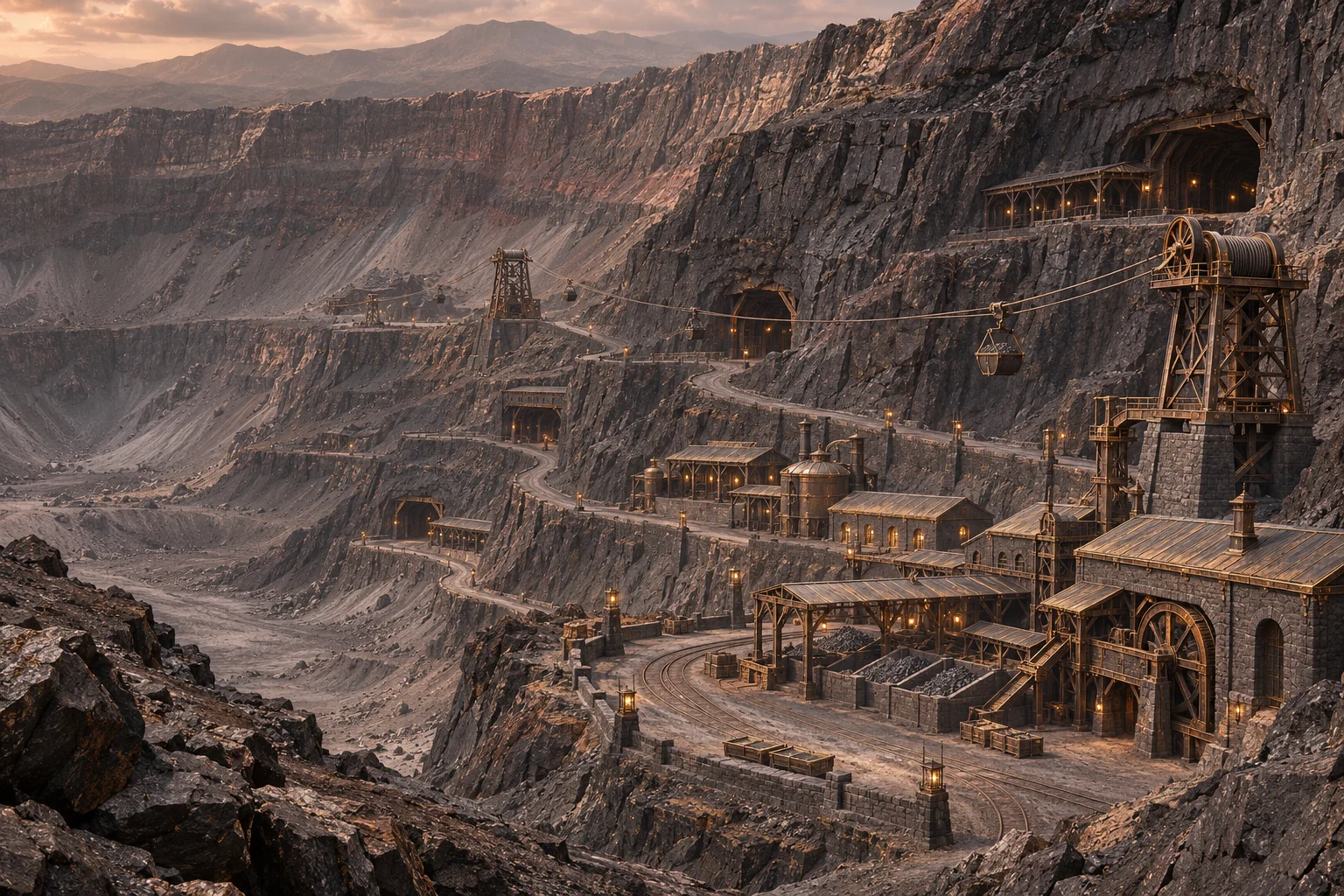
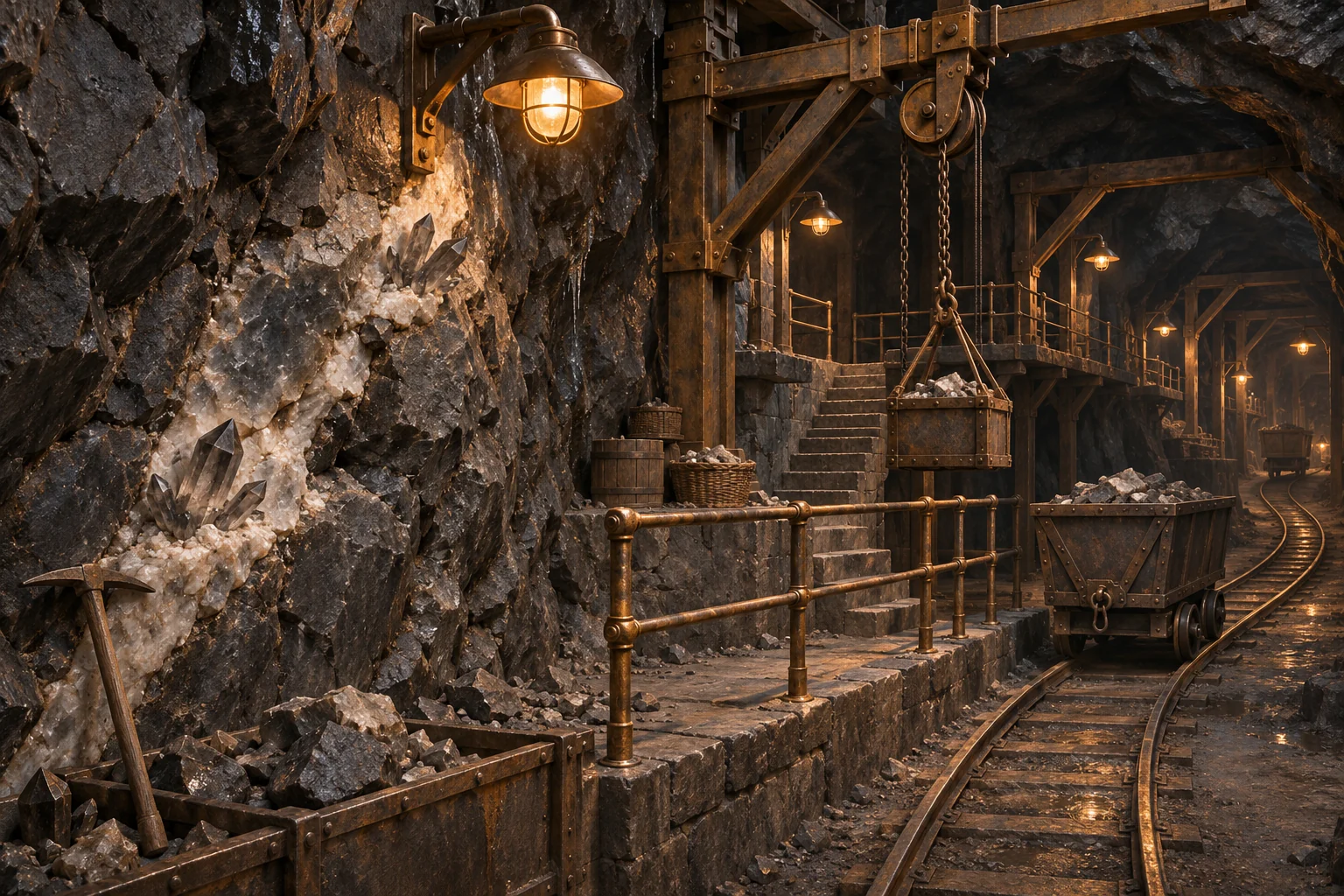
The Maw of Dazhuk is the principal Tear-extraction complex of Tarek, excavated within the caldera system of Dazhuk, the volcano known in Aqmorita tradition as Qur’Daq. Located east of Zarakh along the Khur-Tarek Ridge, it anchors Tarek’s control over the eastern mineral fields and the veins extending through its territory and into the disputed reaches of the Ridge. The complex, its access routes, extraction works, processing infrastructure, and surrounding deposits are controlled by House Malurk under Ak-Malurk the Gray. Unlike the Maw of Zarakh, which belongs to the Akdar sphere of extraction, Dazhuk represents Tarek’s competing source of Tears and gives Ak-Malurk substantial economic and strategic leverage over Enkora’s energy network.
Explore Dazhuk / Qur’Daq ↗ · House Malurk’s extraction network ↗
Complementary volcanic districts
Qur’Dareq and Qur’Veqar are two lesser volcanic massifs under Malurk’s authority. Their surrounding extraction districts complement the Maw of Dazhuk and support Tarek’s wider Tear production. Neither approaches Qur’Gal / Zarakh in scale. The Khur-Tarek system connects these sources through mineral-bearing formations, contested approaches and separate processing routes.
The deep workings
One district concentrates deep galleries that follow older fractured rock and mineral-bearing formations. Its industry depends on survey, ventilation, water control, reinforcement and the movement of heavy loads through a limited number of safe approaches.
The outer workings
The other district combines accessible flank deposits, older caldera formations and regional transfer and processing yards. Separate access routes allow extraction and dispatch to continue when another part of the network is interrupted.
Volcano size alone does not determine mineral output. The extent and quality of the deposits, the history of fracturing and hydrothermal circulation, workable access and sustained labor determine how much can be recovered. Mining follows suitable rock around and beneath the volcanic system; settlements and permanent freight installations stand on stable ground away from eruptive channels.
Dazhuk and its complementary districts give Tarek production of its own rather than a claim dependent entirely on the Maw of Zarakh. Local sorting, treatment, repair workshops and reserves allow Malurk to negotiate as a major supplier, although quality, transport and the cost of safe extraction continue to limit what mineral wealth can achieve.
The Tears and their formation ↗ · The movement of mineral freight ↗
THE OLDER SHADOW ECONOMY
Trade beyond the declared routes.
In the years after the conquest, Malurk’s struggle with Kharet extended into commerce. Alongside declared mineral sales, clandestine channels carried Tears through intermediaries and peripheral markets. They connected buyers denied favorable terms, Houses seeking an alternative supply and powers hostile to the Kal-Muzar.
Those channels offered more than an undeclared cargo. Access to another supplier could loosen a House’s dependence on Kharet, while repeated deliveries created relationships that formal diplomacy could not acknowledge. Mineral wealth became a means of cultivating influence without declaring another territorial war.
The network grew from older rivalries, exclusion and the practical need to keep supplies moving. Its history does not make every Tarek shipment illicit, nor does contact with Aqmorita traders establish criminality. Much of the Domain’s economy rests on open work and exchange; the clandestine trade formed a separate instrument of power within it.
POWER WITHIN THE KAL-MUZAR
Strong enough to bargain. Bound to negotiate.
Territory, a major army and large-scale extraction make Tarek a substantial counterweight to Kharet. They do not supply every resource its settlements and forces require. Water, food, transport, specialized knowledge and access to buyers continue to bind its independence to other powers.
Different strengths across the union
Kharet combines institutions, technical infrastructure and industrial influence. Nivek brings water management, grain and distribution. Ashkur sustains inland corridors; Gorath connects markets and commercial information; Tharen supplies salt and routes through the withdrawn coast. Irek-Nal maintains eastern connections, while Surian’s southern workshops and frontier contacts form another source of materials and access.
A vote that cannot be multiplied
Tarek has one ordinary Council vote, just like every member Domain. Its mineral output, territorial size and army give Malurk leverage outside a tally, but cannot create additional seats. Agreements remain necessary because the powers at the table can supply, carry, withhold or obstruct different parts of the same economy.
CRAFT · INFRASTRUCTURE · EXCHANGE
What sustains its power.
Mining and survey
Extraction begins with knowing the rock: locating a workable vein, measuring instability and deciding which gallery can bear the next stage of excavation.
Metalworking and repair
Forge courts repair mining equipment, lifting gear and the fittings that keep heavy freight moving. Industrial skill supports both extraction and the Domain’s military strength.
Transfer and access
Protected loading courts and mountain roads connect galleries to buyers and processors. A valuable seam can remain unusable when its access route is cut.
Every workshop depends on inputs beyond its gate: water, food, energy, workable materials and a route to its destination. Specialization gives the Domain influence while keeping it connected to the rest of Enkora.
An army of its own.
Ridge garrisons
Fortified approaches, narrow passes and loading roads favor troops trained to hold difficult ground. Their task is to preserve access without turning every border dispute into an open war.
Engineer detachments
Military engineers maintain crossings, reinforce damaged approaches and work beside the specialists who understand the ridge. Rockfall and a severed freight route can defeat a force without a battle.
Territorial command
Tarek fields its own army under the authority of the Regent. House Malurk’s forces retain their House identity within the larger territorial organization.
The Domain commands its territorial army; Houses retain their own forces and affiliations. A Kal-Muzar campaign can establish a temporary unified command, without creating a permanent planetary army.
Territorial military emblem
The Domain’s military standard
Basalt black · copper
Symbols of territory and authority.
The emblem’s angular rock forms and central cleft carry the visual identity of a divided, mineral-bearing ridge.
The Domain banner, civil seal, Regent’s insignia and military standard identify different functions. House symbols remain the marks of a lineage within that larger territorial order.
Domain emblem
Territorial identity.
Domain banner
The territory represented in its colors.
Domain seal
Authentication of territorial acts.
Regent’s insignia
The office representing the Domain in the Kal-Muzar.
Military mobilization emblem
The Domain’s forces assembled with House contingents.
Military standard
Territorial mobilization and the army in the field.
Life beneath the banner.
Work under the ridge
Shift changes, inspections and the movement of mineral freight set the rhythm of mining settlements. A stoppage can protect lives while also cutting wages and delaying deliveries.
Authority and memory
House Malurk’s rule rests on present control as well as a violent political inheritance. Loyalty to the territory, loyalty to its ruling House and acceptance of a shared Council are not necessarily the same conviction.
A local custom
A broken tool is repaired before it is discarded; the maker’s work remains visible in the seams. In frontier settlements, dependable craft earns a reputation that can travel farther than a title.
Continue through the Domains
Return to the eight Domains ↗Volcanic resources and territorial claims
Explore how calderas, mineral veins, processing and routes connect geological wealth to political authority.