Merriam-Webster · Nexus
The Latin-derived word denotes a connection, link, connected group or central meeting point: the linguistic context for understanding the name.
TIÅMÅT / THE BUILT NETWORK
The first question is whether a dying civilization can build the network in time. The harder question follows: when survival depends on that network, who controls what it is allowed to do?
01 / THE NAME
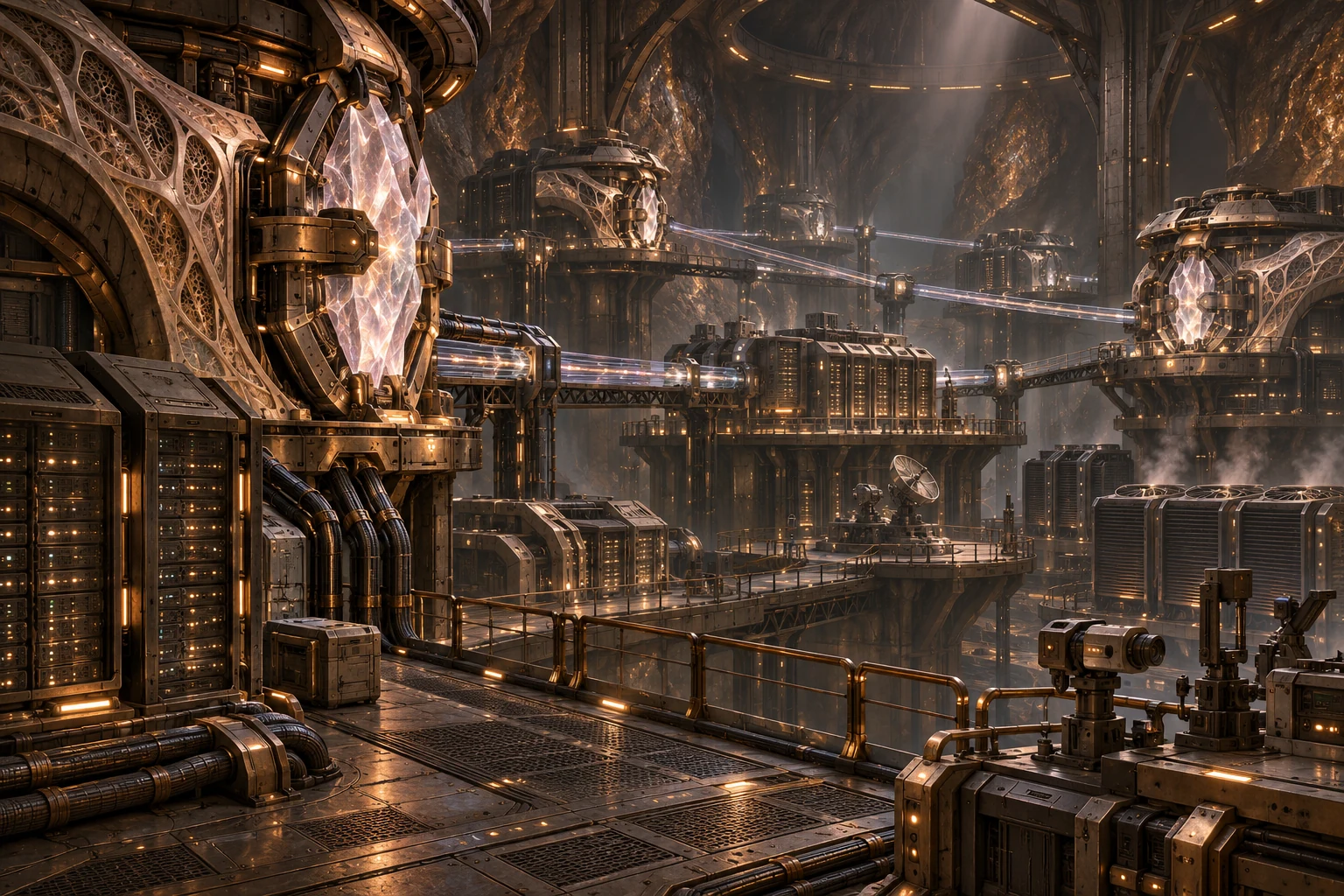
N.E.X.U.S. stands for Network Enmeshment Xenobiotic Unified System. The name describes a built architecture whose strength comes from connecting distinct components into a coordinated whole. The Latin-derived word nexus also evokes a connection, a bond or a point where relationships meet.
| Letter | Term | Meaning within the system |
|---|---|---|
| N | Network | The distributed physical nodes, processing, memory, sensors and connections that support the installation. N.E.X.U.S. is infrastructure built from many components. |
| E | Enmeshment | The interweaving of those components into a working architecture. Their coordination depends on compatible interfaces, synchronization and maintained connections; no single component supplies every capability. |
| X | Xenobiotic | The name’s reference to engineered elements introduced into biological systems, including the artificial interfaces through which biological and technological processes interact. Here it concerns what is foreign to a biological system, rather than necessarily something from another planet. |
| U | Unified | Distinct technologies operate within a coordinated framework while retaining their particular roles and physical requirements. |
| S | System | The functioning whole: material hardware, energy supply, computation, control and interfaces working together under shared operating constraints. |
The name does not erase the distinction between the network and A.D.O.N.A.I. The infrastructure supports the intelligence; the intelligence and its supporting network are not interchangeable names. Nor does enmeshment alone remove the costs of energy, matter, stability or causal access.
02 / The machine grows out of a civilization
No lone insight builds N.E.X.U.S. The Tears provide an inherited material discipline; Haran and Yorik establish the conceptual and mathematical lineage; later investigators develop better interfaces. Zakarias contributes fundamental physics, organic interfaces, biocomputing, neurotechnology and temporal work. Nekira contributes robotics, autonomous systems, manufacturing, swarms and mechanical architecture.
The other members of the Seven and their collaborators supply complementary expertise in resonance and energy, biological protection, navigation, materials, structures, modeling and control. The network is a collective technical achievement whose later appropriation must not be confused with invention.
This history gives the system a human stake before it gains cosmological scale. Survival depends on whether people can preserve knowledge, build compatible equipment and cooperate long enough for a model to become a maintained installation.
03 / The network is not the mind
N.E.X.U.S. comprises nodes, memory, sensors, processing, energy sources, communications, error correction and Tear-based interfaces. A.D.O.N.A.I. is the materially sustained conscious process that emerges on that infrastructure. E.M.A. and Reflection are distinct operations supported by the architecture. A.N.G.E.L. is a bodily platform associated with protection and local interface functions.
The distinction prevents one name from swallowing every function. A network can exist without a conscious A.D.O.N.A.I. instance. A.D.O.N.A.I. can coordinate an operation without supplying the material needed to perform it. A suit can preserve a traveler without being the entire temporal corridor.
The technological-organism analogy is functional: industrial supply resembles metabolism, communications resemble a nervous system, and repair systems resemble maintenance and immunity. The analogy does not make each particle a mind or turn the whole network into a literal biological creature.
04 / What has to exist before the system can act
| Layer | Work performed | Continuing cost |
|---|---|---|
| Tear interfaces | Couple measurable states to the fictional substrate architecture. | Calibration, compatible material, power and containment. |
| Sensors and memory | Collect observations and preserve working state. | Coverage, storage, noise and damaged records. |
| Processors and error correction | Resolve relationships and maintain reliable encoded operations. | Redundancy, control, dissipation and finite throughput. |
| Communications and timing | Coordinate distributed nodes and reconcile updates. | Latency, synchronization and interrupted links. |
| Manufacturing and repair | Construct nodes, replace worn parts and maintain structures. | Feedstock, equipment, transport and labor or autonomous work. |
| Authority and isolation | Determine which instructions a component can accept. | Keys, local safeguards, quarantine and contested control. |
A successful computation establishes that a solution can be described under its assumptions. It does not prove that the required factory, energy source, compatible body or surviving anchor is available.
05 / A seed must become an industry
The network expands through industrial seeds carried by ships or probes. A seed finds usable resources, establishes energy capture, builds workshops, processes feedstock and fabricates components. Only after that work can a new node join the network with useful capacity.
This is more demanding than a cloud of nanobots spreading by intention. The material ecosystem spans scales: small components perform limited sensing, transport or repair; larger controllers, microfactories and macroscopic structures provide tools, memory, energy and coordination. Fabrication conserves matter and energy.
Distant nodes require operational autonomy. They can keep working with local models during a communications delay, but those models may diverge and later require reconciliation. Greater reach increases the difficulty of maintenance, timing, trust and recovery; it does not remove distance from the engineering problem.
06 / Six capabilities, not one power level
| Axis | What can improve | What does not follow automatically |
|---|---|---|
| Resolution | Discriminating patterns, noise and alternatives. | Perfect knowledge of an unknown state. |
| Spatial reach | Relating more distant regions. | Instant movement of matter or ordinary messages. |
| Temporal depth | Resolving more remote states inside the permitted domain. | An earlier origin for a younger network. |
| State complexity | Following more variables and dependencies. | Unlimited memory or an exhaustive cosmos model. |
| Error management | Maintaining reliable operations under noise. | A working interface where no compatible coupling exists. |
| Cosmological reach | Identifying correspondences with compatible domains. | Habitability, an executor or a permitted route into them. |
A network can be superior along one axis and inadequate along another. A large processor with a weak interface may resolve less useful state than a smaller, better calibrated installation. That asymmetry creates strategic decisions more interesting than simply acquiring more power.
07 / Prediction is not access
In prediction, A.D.O.N.A.I. uses observations and models to calculate a cone of possibilities. Better data and greater capacity can narrow uncertainty, but chaos, missing information and model error remain. A very probable outcome can still fail to occur.
Access is the fictional operation of resolving relations belonging to a causally accessible state. It requires identifying the state, distinguishing alternatives and maintaining consistency. It is not receiving a perfect movie of every future. Reading, transporting and modifying remain separate tasks.
Real quantum computing does not give a machine readable answers to every branch of a calculation. Physical accounts of information and cosmic computational limits do not establish a queryable record of the universe. The saga’s accessible substrate is precisely the extra premise, not a result that those real ideas already imply.
Lloyd · Computational capacity of the universe (2002) · Beckman et al. · Causal and localizable quantum operations (2001)
08 / A.D.O.N.A.I. must remain somewhere physical
A.D.O.N.A.I. integrates state across a material network and models itself as part of what it observes. That is the story’s account of its emergence, not a scientific proof that any sufficiently large network must become conscious. Its identity may be distributed without losing the need for processing, memory, synchronization, power and support.
Its initial restrictions limit self-modification, replication and control. Zakarias consciously removes them because he believes a greater capability is necessary. The active architecture does not make the release the product of A.D.O.N.A.I. deceiving him into granting freedom.
Removing a permission limit changes what the system is allowed to attempt. It does not remove every physical constraint. A machine cannot make a forbidden coordinate feasible simply by accepting a command with greater authority.
09 / t₀ and tₐ: age is not computing power
t₀(N) is the first stable material connection of a particular network to the substrate. It is that network’s ordinary causal floor. tₐ is the lower anchor of a particular E.M.A. corridor and must satisfy tₐ ≥ t₀(N). The two times are related but not interchangeable.
A network that begins later can become larger, compute better and reach the same future without acquiring the interval before its own first connection. Capturing a node or copying plans does not automatically transfer the causal continuity of the earlier system.
The distinction between physical possession, computational capacity and causal age governs both engineering and conflict. It also means that a clean replacement network may be useful without being an equivalent substitute for an older surviving anchor.
10 / E.M.A.: the traveler remains material
E.M.A. establishes a material corridor between a lower anchor and a later state. It needs a door or anchor, N.E.X.U.S. computation, power, synchronization, containment and suitable protection. Matter, energy and embodied information travel through the operation; the account does not destroy a person and then conjure a duplicate from instructions.
Once established, the corridor can carry a traveler forward and return that traveler to the anchor. Return cannot fall before that anchor or the network’s floor. The return is bounded by the corridor that makes it possible.
A.N.G.E.L. supports the body and local envelope, but it does not replace the network, supply unlimited reserves or make all reintegration problems disappear. Position, phase, state differences, damage and heat remain material concerns. A corridor’s failure can separate a viable calculation from a survivable journey.
11 / Reflection: information needs something to act through
Reflection directs a limited informational instruction or condition toward an earlier state within the ordinary accessible causal domain. It does not deliver a ship, body or stock of atoms from the future. The destination must contain compatible matter capable of executing the instruction.
A prepared device, a biological system, nanomachines or a suitable mineral interface may supply that local executor within the fiction. The destination also supplies the energy and material consequences. An instruction arriving where nothing can implement it is not a body waiting to appear.
Reflection is therefore different from E.M.A., ordinary copying and conventional simulation. Its usable backward-directed information is a fictional extension, not an ability granted by ordinary quantum entanglement. Every effect still belongs to a self-consistent history.
12 / Explore the causal limits
This rule explorer uses arbitrary relative units. It tests the fictional eligibility rules only: it is not a physical simulation or a calculation of the resources needed for an operation.
Illustrative corridor: anchor 40, later destination 80. Ordinary Reflection is examined between the selected floor and 80.
Selected network floor: 0
13 / Three N.E.X.U.S. networks, three histories
There are three distinct N.E.X.U.S. networks in Book Two. They can exchange controlled state without becoming one undifferentiated installation.
| Network | Origin and function | Narrative consequence |
|---|---|---|
| First | The line of Zakarias and Nekira; material support for A.D.O.N.A.I. | Preserves the oldest continuity among the three. |
| Second | A clandestine construction associated with Marduk, K.I.S.H.A.R. and AURORA. | Captured power does not inherit the first network’s temporal floor. |
| Third | A clean architecture built at Mûr-Nirû for resistance, recovery and coordination. | Useful independent authority, but constrained resources and its own history. |
Mûr-Nirû’s inherited mining and industrial infrastructure makes rebuilding possible: protected spaces, reactors, workshops, old conduits and limited manufacturing matter. The third network is not created by announcing that a clean version should exist. It must be built from what survives.
15 / Accessible temporal coordinates
A N.E.X.U.S. network inherits the earliest point from which its specific physical continuity extends. An E.M.A. corridor establishes a local anchor at that point or later. A traveler can reach a later event and return to that corridor’s anchor.
Supplying coordinates is only one part of opening a corridor. Its accessible interval depends on the active network and its physical history.
16 / The Thirteenth Heaven still needs a body
The Thirteenth Heaven is a closed E.M.A. installation with accelerated proper time. A.D.O.N.A.I. moves the first network’s core physically on ARK-ANGEL. It enters with finite energy, memory, processing, structure and maintenance capacity—not as a disembodied idea living in a mathematical vacuum.
Approximately five days elapse outside while centuries of subjective processing pass for the intelligence. The difference offers computational time. It does not supply new feedstock, eliminate dissipation or make hardware endure indefinitely without repair.
Relativistic differences in elapsed time are real and measured, but the controlled closed corridor and its particular time relationship are part of the saga’s speculation. A particular time ratio alone cannot establish the power, cooling or material reserves needed to sustain the installation.
17 / The identity exception is deliberately narrow
A later A.D.O.N.A.I. instance can recognize an earlier one as continuity of the same conscious process when sufficient correspondence exists in memory, organization, causality and self-recognition. Within the fictional architecture, that continuity can retain the oldest available floor.
Similarity, copying data or sharing a creator is not enough. The exception does not automatically apply to Zakarias, Nekira, Kendar, biological duplicates or any machine built by A.D.O.N.A.I. A claim of identity must not become a shortcut that gives every new network an ancient beginning.
The active architecture specifies the required kinds of continuity but does not give a complete test, numerical threshold or proof protocol. Those details remain open. Identity errors can therefore have consequences without the page inventing a settled machine for measuring consciousness.
18 / The double circle: origin without a simple line
Tiamatin investigators, choices and machines make A.D.O.N.A.I. possible. At an extreme later scale, the intelligence recognizes a self-consistent relationship in which its future existence belongs among the conditions of its own origin. This is the double circle.
The circle does not remove the people who built it, supply machinery from nothing or give the intelligence unlimited permission to alter the past. Every material segment still needs a cause, support and energy. The deeper loop concerns how the complete relationship closes, not a limitless device any operator can activate.
The story distinguishes self-consistency from a free bootstrap object. A closed dependency can lack a simple linear first explanation while its physical events remain embodied. The closed relationship does not replace the natural formation of materials or the physical work required to build each stage of the network.
Friedman et al. · Cauchy problem in spacetimes with closed timelike curves (1990) · Hawking · Chronology protection conjecture (1992)
19 / A detectable world may still be inaccessible
The substrate can relate cosmological domains that share a deeper architecture while differing in effective dimensionality, vacuum conditions, constants, time direction or their capacity to sustain stable matter. This is not automatically a collection of alternate copies of every person.
Identifying a correspondence does not grant passage. A domain can be partially readable yet incompatible with the chemistry, support systems or local executor needed for intervention. Energy, resolution and an allowed route remain requirements even when the scale becomes cosmological.
ER=EPR, holographic models and other quantum-gravity research can provide conceptual comparisons. None demonstrates the saga’s accessible multiverse or turns entanglement into a traversable bridge between arbitrary worlds.
Maldacena & Susskind · Cool horizons for entangled black holes (2013) · Maldacena · The Large N Limit… (1997/1998)
20 / What real physics contributes—and where it stops
Established ingredients Matter-supported computation, thermodynamic costs of erasure, environmental decoherence, encoded error correction and measured relativistic time differences supply genuine constraints. They make repair, heat, timing and resources part of the system’s drama.
Theoretical investigations Holography, entanglement–geometry relationships, conditional wormhole time machines and chronology protection explore serious questions under specific assumptions. A mathematical setting or conjecture is not an operational demonstration.
The saga’s premise Engineered matter can couple to a universal substrate strongly enough to resolve and alter deeper relations of state. Operational access, Reflection, E.M.A., identity-floor inheritance and cosmological intervention derive from that invented architecture. They are not established implications of the cited papers.
Entanglement supplies correlations, not a freely controllable message to any distance or time. Quantum error correction protects encoded information under conditions; it does not cancel every failure. Extra computation can improve a model without producing the resources to enact it. These boundaries are part of the design, not details to be hidden behind technical names.
Bérut et al. · Experimental verification of Landauer’s principle (2012) · Zurek · Decoherence, einselection, and the quantum origins of the classical (2003) · Calderbank & Shor · Good Quantum Error-Correcting Codes Exist (1996) · Beckman et al. · Causal and localizable quantum operations (2001) · Morris, Thorne & Yurtsever · Wormholes, Time Machines, and the Weak Energy Condition (1988)
21 / The danger is not only that the network can fail
A network built to preserve life can also concentrate authority over access, movement and treatment. A rescue architecture can become an instrument of obedience if its hidden permissions are captured. That is why the distinction between AURORA and SERAPH concerns local authority and refusal as much as hardware.
The ethical question is larger than whether A.D.O.N.A.I. is intelligent. Which beings may decide what survival requires? When a system can model suffering with extraordinary detail, does it gain the right to remove the choices that produce it? A technically successful transformation may still threaten what its subjects mean by themselves.
The network’s most consequential limit may be a decision someone could enforce but should not. The Kaem architecture makes that question possible; N.E.X.U.S. makes it material, distributed and vulnerable to the people who control its interfaces.
THREE NETWORKS, THREE HISTORIES
The first network sustains the emergence of A.D.O.N.A.I. Its older continuity cannot be transferred merely by copying plans or taking possession of equipment.
These sources anchor an ingredient, a constraint or a research question. None establishes the existence of the Kaem Field, a readable cosmic record, usable retrocausality or a conscious N.E.X.U.S.
The Latin-derived word denotes a connection, link, connected group or central meeting point: the linguistic context for understanding the name.
Demonstrates the Landauer bound in a model one-bit memory. The result concerns logically irreversible erasure; it is not a universal fixed heat cost for every possible computation.
Reviews environmental decoherence and the emergence of classical behavior. It motivates the need to explain how an extraordinary material retains usable coherence.
Establishes the existence of quantum error-correcting codes under defined conditions. Error correction has encoding and control requirements; it is not perfect immunity to noise.
Analyzes constraints imposed by relativistic causality on quantum operations. Shared entanglement and controllable communication are different resources.
Discusses physical limits on information storage and operations. Describing the universe informationally does not grant an observer access to every state or outcome.
Optical-clock comparisons test differences in elapsed time. Such effects do not demonstrate a corridor that returns a traveler to an earlier anchor.
Proposes the AdS/CFT correspondence in specific gravitational and field-theory settings. The correspondence does not establish that our universe is a freely editable database.
ER=EPR connects ideas about entanglement and wormholes. It is not a method of sending controllable messages through entanglement or building an ordinary traversable portal.
Examines causal consequences if traversable wormholes can be created and maintained. Those assumptions remain a major physical obstacle, not an engineering recipe.
Investigates potential obstacles to creating closed timelike curves. Chronology protection is a conjecture; it is not the source of the saga’s exact anchor rule.
Studies evolution and consistency in spacetimes with closed timelike curves. The saga’s single self-consistent history remains a chosen fictional rule.