Kunak
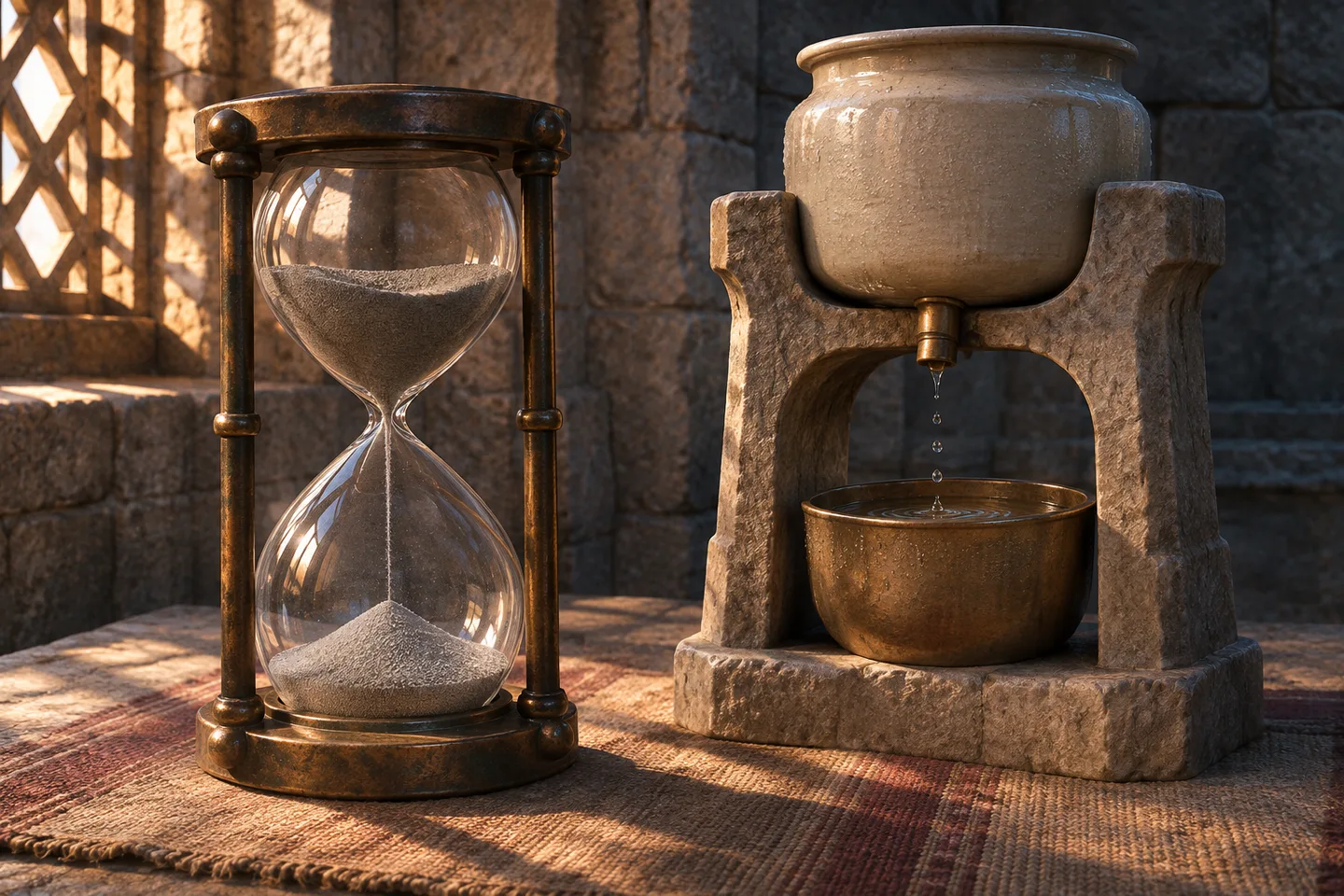
The Akkad clock runs with sand, ash or mineral powder. A run marks a Vuelta and can be read underground or during darkness.
TIÅMÅT / CALENDAR & MEASUREMENT
A watch, a lifetime and a changing climate belong to different clocks. Tiåmåt’s calendar keeps the scale of a person separate from the long motion of the planet.
One Cycle contains two Vigilias or four Jornadas. These are alternative divisions of the same day. A Jornada orders a work shift; a Vigilia spans a longer watch.
| Unit | Relationship | Use |
|---|---|---|
| Cycle | One full day · approximately 40 Earth hours | Daily life and journeys |
| Vigilia | ½ Cycle = two Jornadas | Long watches and operations |
| Jornada | ¼ Cycle · approximately 10 Earth hours | Work and guard shifts |
| Vuelta | One short run of a Kunak; roughly an Earth hour | Tasks, waits and marching intervals |
| Grano | A small interval without a fixed conversion | Fine timing limited by the instrument |
Earth equivalents use the approximate 40-hour Cycle. Vuelta, Grano and Bēruk have no universal exact conversion.
A civil year contains 216 Cycles: nine traditional months of Uruk, each 24 Cycles long. Eak’s Awakening opens the year ceremonially. These units organize ages, contracts, harvest records and family memory.
Civil months are not the present physical orbital periods of the moons. Nor does the sky return to a perfect annual arrangement. The calendar remains useful while the moons continue moving.
Explore the physical moons ↗The Akkad clock runs with sand, ash or mineral powder. A run marks a Vuelta and can be read underground or during darkness.
A Hakbiru water clock measures duration through flowing water. Its materials express a different relationship with a resource scarce elsewhere.
Takbiru’s height, Takmat’s relative position and the turn of shadows provide references where visibility permits.
Aqmorita journeys can be reckoned through pace, effort, ridgelines, veins and familiar resting places.
A Pulso is a perceptible beat or variation of the Tear network. It is not a unit of time.
One planetary orbit lasts about 1,324 Earth years. Eight broad Mareas describe the world at a scale spanning generations. They are not civil months, and a person’s age is not counted in planetary orbits.
A Bēruk is the distance a loaded Akkad column covers while a Kunak empties once. Slope, load and pace affect the distance. Road monoliths mark administered routes; natural monoliths are landmarks without uniform spacing.
REAL-WORLD CONNECTIONS
These sources explain the real physical or social principles discussed here. Tiåmåt’s peoples, places and institutions belong to the fictional world.